Guide · General
Software Licensing Contract Terms and Costs Explained
Software licensing contract terms explained: the clauses that drive cost, audits, renewals and AI data use, with sourced 2026 figures.
By the Rankozo research desk · Updated November 14, 2026 · 14 min read
The number on the order form is the least reliable number in a software deal. A license fee is a starting position. What an organization ends up paying is set by the unit the vendor counts, the mechanics that fire at renewal, and the audit clause that measures compliance long after the invoice is paid.
The size of the exposure isn't abstract. The U.S. Government Accountability Office reported that the U.S. Department of Veterans Affairs planned to spend approximately $985 million on software, including commercial software licenses, in fiscal year 2025. One misread clause about who counts as a user, or what counts as a deployment, scales with a budget that large.
Read a software licensing contract in the order money moves. Metric first, because it multiplies. Term and renewal second, because they repeat every year. Audit third, because it reaches backward. Data rights and open-source obligations last, because they arrive as engineering work and legal bills rather than as a line on the invoice.
Table of Contents
- Core Terms That Set What You Pay
- How Perpetual, Subscription and Open-Source Licenses Differ
- Pricing Metrics and Renewal Uplifts That Drive Cost
- Audit Clauses and True-Up Exposure
- Open-Source Obligations and Source-Code Escrow
- AI Data Rights Your Contract Must Spell Out
- Confirm These Terms Before You Sign
Core Terms That Set What You Pay
Three clauses decide the price before anyone negotiates a discount: the license metric, the term, and the audit right. The onboarding fee, the support tier and the training credit move the total by a rounding error next to those three.
A license behaves like a lease, not a receipt. The metric decides how many rooms you may occupy and who may sit in them. The term decides how long the lease runs and what renewal costs. The audit clause gives the landlord the right to inspect, with a bill attached when the head count doesn't match.
Scale makes each clause matter more than it looks. A U.S. Government Accountability Office review, described in Shopify's enterprise guide to software license audits, found that one federal agency's software-license inventory covered more than 12,000 publishers and over 4 million individual software licenses. With records that fragmented, nobody can say whether the estate is over-bought or under-bought. The same review noted one major federal agency reporting approximately $181 million in savings in 2012 by consolidating enterprise license agreements, even while its oversight process was described as ad hoc.
Nine clauses carry the cost. Each needs a written answer, not an assumption.
| Clause | What it must define | Cost if left vague |
|---|---|---|
| Grant of license | Who may use the software, which entities, sites and devices | Use outside the grant can be treated as unlicensed use |
| License metric | Named users, concurrent users, processors, virtual machines or units | Infrastructure changes can be read as new deployments |
| Term and renewal | Start and end dates, renewal method and cancellation deadline | Automatic renewal at list price |
| Fees and price adjustment | Fixed price or economic adjustment, and any renewal cap | Open-ended increases at each renewal |
| Upgrades and versions | Included versions and new-release entitlement | A low subscription may exclude new versions |
| Audit | Notice period, frequency, data access, measurement and cure period | True-up payments and backdated fees |
| Termination and data return | Access, export and deletion after expiry | Loss of access or data on the last day |
| Open-source and third-party components | Notices, source availability and who fixes non-compliance | Remediation falls on the buyer |
| AI features and data use | Training rights, retention, model changes and subprocessors | Customer prompts reused by shared models |
A ten-person team signs ten named-user seats. Six months later it brings in fifteen contractors, and each one needs the tool. The grant names employees of one entity only, so every contractor session is unlicensed use under a metric nobody checked, and the true-up arrives with the audit rather than with the invoice. The fix costs one sentence at signature: contractors and affiliates named in the grant, with seats sized to the peak month rather than the hiring day.
The Three Clauses to Read First
Every row in that table matters, and three of them decide most of the money: the license metric, the renewal and price adjustment terms, and the audit clause. Read those three against real headcount, real devices and real infrastructure before reading anything about features.
Read in this order: metric, renewal, audit. A discount negotiated on a badly metered contract buys a cheaper first year and a more expensive third.
Rankozo's software price comparison helps with the first of the three, because it puts per-seat and per-account list prices side by side, and those two units are rarely the same deal.
How Perpetual, Subscription and Open-Source Licenses Differ
Buying once, renting for a term and using open-source components are three different financial arrangements, not three labels for one purchase. The choice changes when cash leaves, how long rights last, and whether new versions land inside the price.
The U.S. Government Accountability Office's report on federal software licenses draws the line plainly. Perpetual licenses grant permanent use rights after purchase. Subscription or rental licenses grant rights for a specified period ranging from days to years, and GAO notes that subscription licenses may or may not include upgrade rights, so a low recurring price does not establish entitlement to new versions.
| Model | Payment timing | Access period | Upgrade rights | Best fit |
|---|---|---|---|---|
| Perpetual license | Large payment upfront | Permanent use after purchase | Not implied; confirm maintenance terms | Stable, long-term use with fixed needs |
| Subscription or rental | Spread across the term | Set period, from days to years | May or may not include upgrades | Short projects or changing headcount |
| Fixed-price SaaS | Fixed charge per seat, unit or term | Continuous for the negotiated term | Written in the contract | Predictable seat-based use with no usage charges |
| Open-source | No purchase price | Ongoing under the license terms | Set by the upstream project | Zero license fee, with compliance work |
The cheapest workable structure is usually a time-limited subscription sized to the seats the team will use for the full term, not to the seats occupied on signing day. Write six things into it: start date, end date, renewal mechanism, cancellation deadline, included version or upgrade entitlement, and what happens to access and data after expiry.
A Crossover You Can Calculate
Illustrative numbers show why the renewal count decides the answer. A perpetual license at $3,600 paid once, against a subscription at $1,200 a year, crosses over in year three. Every year after that, the subscription costs more than the licence it replaced, and the comparison only holds if the subscription delivers new versions the perpetual buyer would otherwise buy again.
Perpetual still wins in one case: stable, long-lived use where the team needs no new versions and can run the software in a controlled environment. Then the upfront payment is the whole cost, and the subscription is a permanent new line item.
One question settles most of the argument. Does this subscription include the next major version, and what happens to access on the day it expires?
Pricing Metrics and Renewal Uplifts That Drive Cost
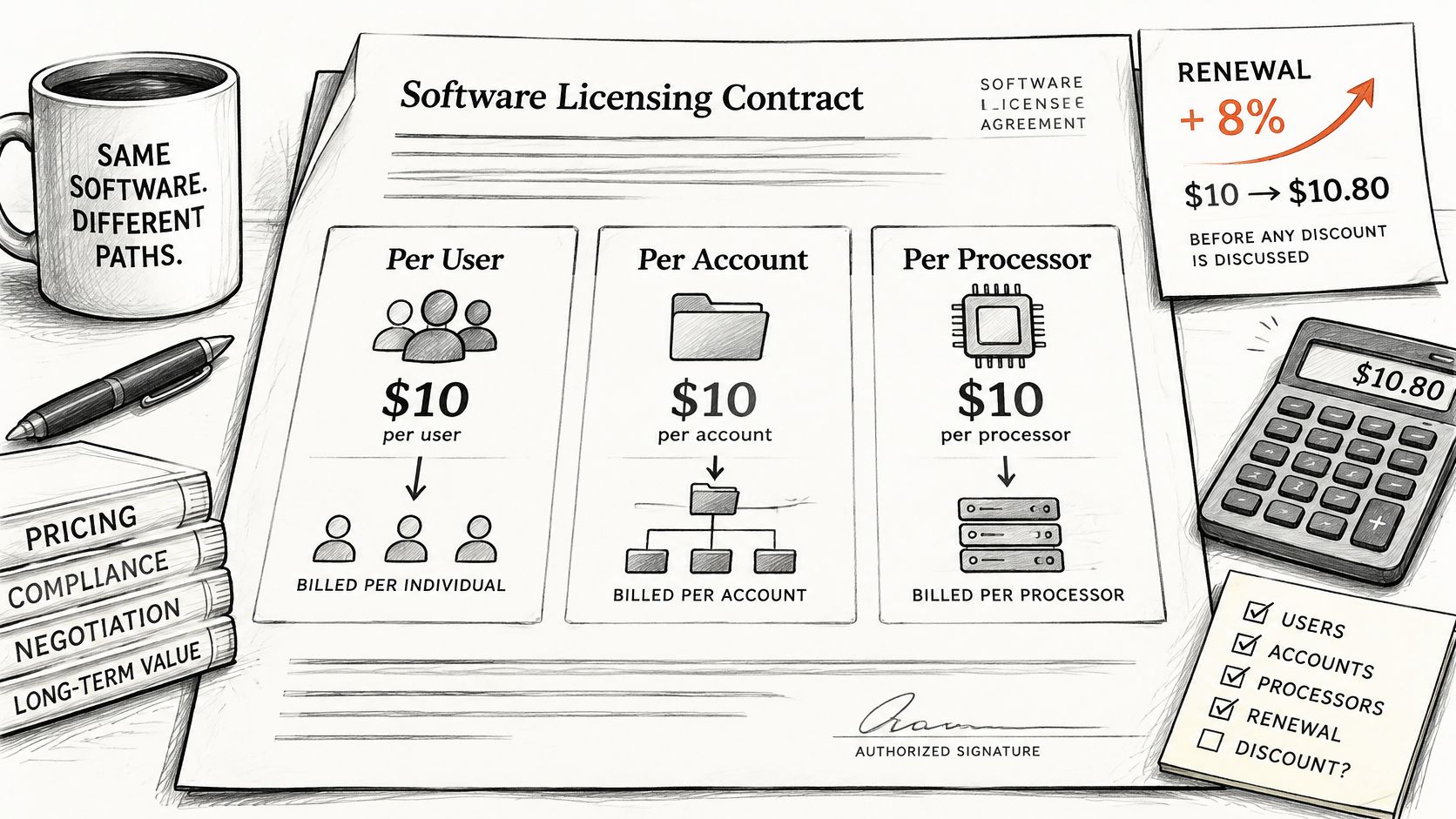
The metric changes the bill before any discount is discussed. $10 per user charges for every person with a login. $10 per account charges once for the whole team. $10 per processor charges for the hardware underneath, so moving a workload to a larger machine raises the price without adding a single person. Vendors price in different units, which is why a $10 per user plan and a $10 per account plan are not the same deal.
The Fixed-Price Test That Excludes Usage Charges
The U.S. General Services Administration's Acquisition Letter MV-2024-01 sets a narrow test for a qualifying fixed-price SaaS license. Access is provided contemporaneously with payment, the license is priced on a fixed-price or fixed-price-with-economic-price-adjustment basis, and the charge is based on a single seat, multiple seats, units or a subscription covering a limited term. No utilization or consumption metric other than quantity may affect costs during the negotiated term, and access must remain continuous and uninterrupted.
A contract charging a fixed number of seats for 12 months passes that test. A contract adding charges for API calls, storage consumed or compute usage fails it. Note what the letter permits as well: an economic price adjustment can sit inside a fixed-price arrangement, so fixed price is not a promise that the price never moves at renewal.
Illustrative only, with no vendor attached: 25 named users at $30 per user per month is $9,000 in year one, and an 8% uplift applied at each renewal builds the following five-year total.
| Year | Annual fee (USD) | Uplift vs prior year (USD) | Cumulative total (USD) |
|---|---|---|---|
| Year 1 | 9,000 | n/a | 9,000 |
| Year 2 | 9,720 | 720 | 18,720 |
| Year 3 | 10,498 | 778 | 29,218 |
| Year 4 | 11,337 | 840 | 40,555 |
| Year 5 | 12,244 | 907 | 52,799 |
Five years of a plan quoted at $9,000 costs about $52,800, which is the number to take to a budget holder. Vendors change prices often, and several have announced increases that take effect after November 4, 2026, so the uplift assumption should be written as a cap rather than left to the renewal letter.
Four Steps to a Full-Term Number
- Write the metric into the contract. Named users, accounts or processors, in the vendor's own words.
- Calculate the year-one total. Seats multiplied by the per-seat rate for the term, with no add-ons mixed in.
- Apply the uplift cap to each renewal. A cap of a few points compounds; an uncapped adjustment doesn't.
- Add the full-term total before signing. The year-five figure is the one the finance team approves.
Rankozo's breakdown of software pricing models is a useful check when offers in one category arrive in different units. The cheapest sticker price loses whenever the metric or the uplift is wrong: a $10 per account plan beats an $8 per user plan for a team of 40, and a capped renewal beats a first-year discount that resets to list price.
Audit Clauses and True-Up Exposure
An audit reconciles deployments, user counts, environments and actual usage against what the contract grants, so a loose audit clause is a cost clause with a delay on it.
Audit activity is common enough to budget for. The 2022 enterprise software-audit survey drew 283 usable responses and found that 69% of respondents had been audited in the previous three years, while 79% had been audited in the previous five.
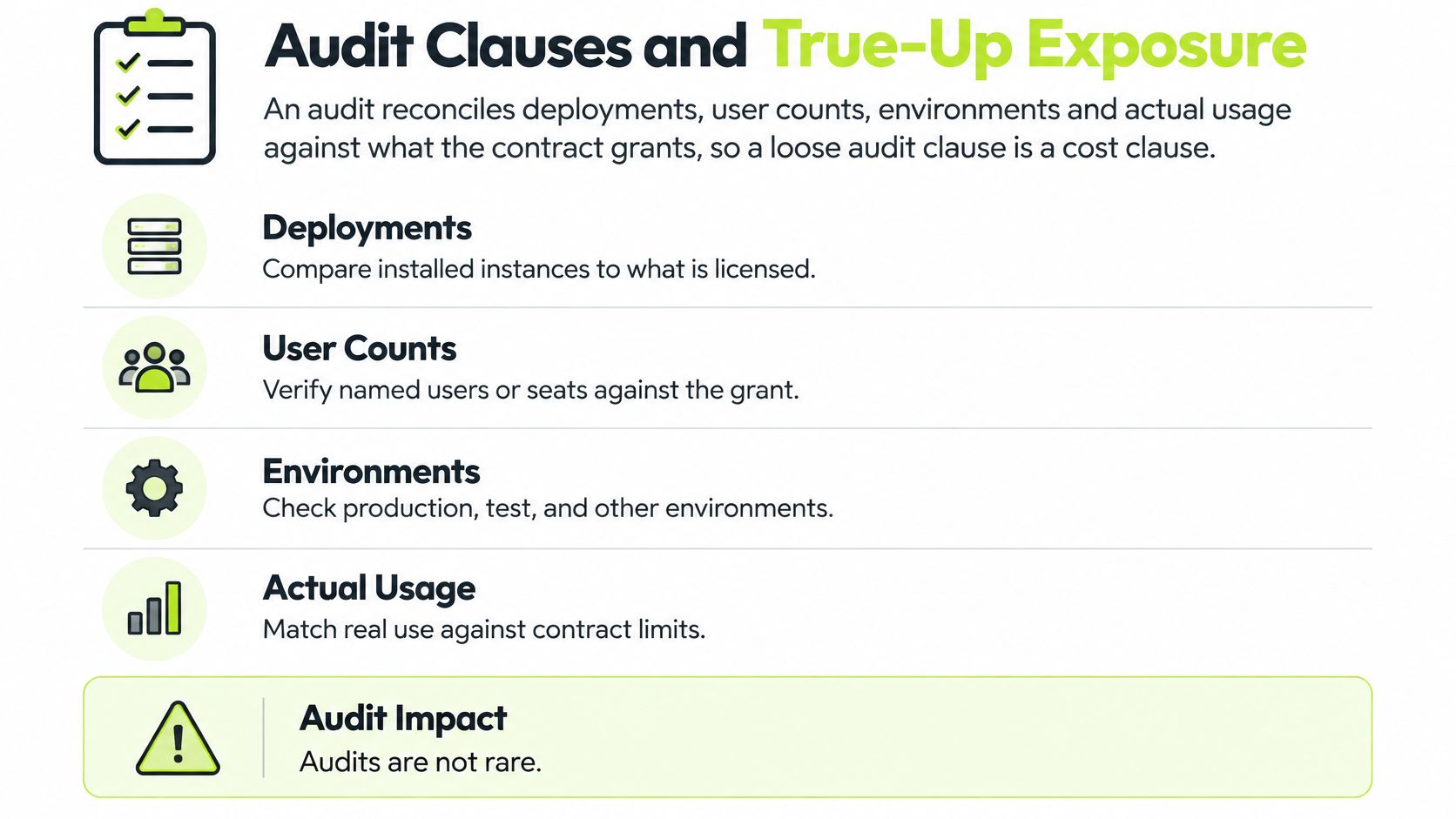
The same survey puts money on the outcome. Among audited companies, 64% were charged additional amounts for non-compliance, and average true-up costs ran to approximately $263,000 for companies with about $50 million in annual revenue and $1.6 million for companies with about $4 billion in annual revenue. That spread makes the audit clause a line item to model: audit probability multiplied by expected true-up is a budgetable exposure, and every term in the clause either shrinks one of those inputs or leaves it alone.
The mechanism is usually duller than deliberate overuse. A team migrates workloads onto new virtual machines, the metric counts processors or VMs, and the vendor reads the new footprint as unlicensed deployment because the contract never defined what a deployment includes. The dispute then turns on wording, and the buyer carries the cost while the wording is argued.
Terms to Negotiate Into the Audit Clause
- Advance notice in writing, long enough to reconcile records before anyone visits.
- Reasonable frequency and business hours, so audits can't run continuously or overnight.
- Confidentiality for findings and independent verification of any measurement the vendor produces.
- A cure period before payment is due or termination is available, since most findings trace back to counting errors rather than intent.
- A named measurement method such as named users, concurrent users, processor capacity, virtual machines or consumption units.
- Evidence rules that state which technical records control when the two sides disagree.
Three actions belong on a calendar rather than in a negotiation file. Keep a current entitlement register that lists every contract, metric and quantity. Reconcile it against deployment records each quarter rather than each renewal cycle, because a gap discovered internally costs a correction while the same gap discovered by an auditor costs a true-up. Assign one named owner who answers the vendor inside the notice window, since a missed deadline in an audit clause is usually read as agreement.
Open-Source Obligations and Source-Code Escrow
Open-source components carry no purchase price and still create work. The Linux Foundation's open source license best practices states that most license obligations are triggered when software is redistributed to third parties. The same component can carry no duty on an internal deployment and a real duty in a customer delivery.
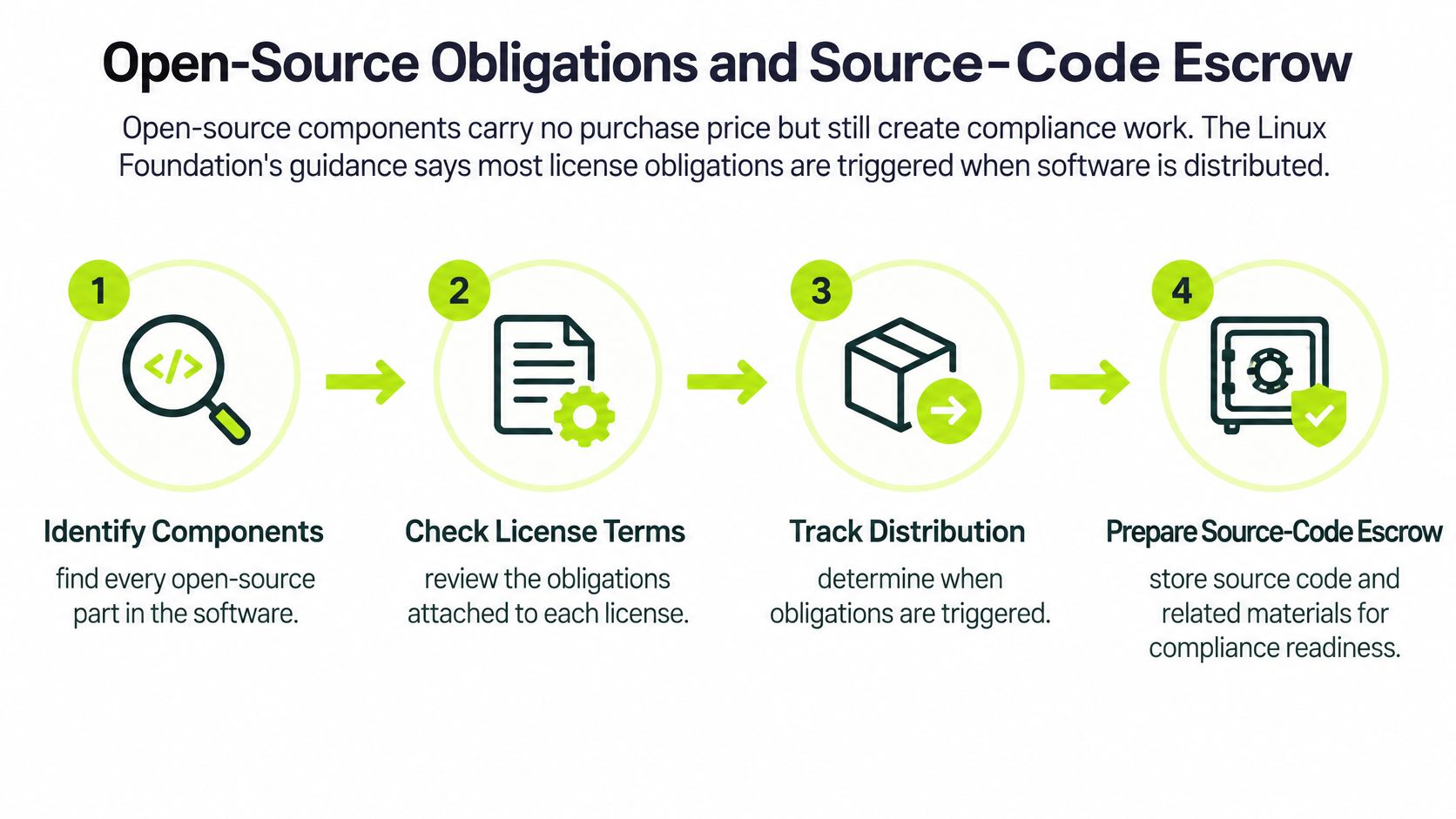
That makes the deployment model a contract term. Internal use, delivery to customers, embedded distribution and hosted service access each produce a different obligation, and a component that needs nothing this quarter can need notices, license copies or source availability after the next release.
Maturity is uneven. Bitkom Research's 2025 Open Source Monitor found that 56% of surveyed organizations reviewed applicable license obligations, 49% reviewed Contributor License Agreements or used license allow and deny lists, and only 37% used ISO 5230 for license compliance.
- Inventory every component, including transitive dependencies.
- Record the license attached to each one, with its version.
- Classify the deployment as internal, delivered, embedded or hosted.
- Attach notices where the license requires them. Microsoft's open-source licensing module recommends an aggregation file such as LICENSES.txt or THIRD_PARTY_NOTICES, with attributions in documentation or an About dialog.
- Prepare source code with build instructions where a copyleft license requires provision.
- Set a remediation deadline and name who pays for it when a vendor-supplied component turns out noncompliant.
What a Source-Code Deposit Must Contain
Escrow protects continuity only when the deposit is usable. Virginia's public-sector procurement guidance recommends depositing source code, upgrades, modifications and related technical and user documentation with a third-party escrow agent, verifying that the files are complete, readable, correctly catalogued and functional, and it uses a 60-day support failure period as a release trigger in one model. Cessation of business is the other common trigger.
A technically effective clause requires build scripts, dependency manifests, configuration files, schemas, deployment instructions, test data or substitutes, and documentation sufficient for an independent engineer to run, maintain and modify the system. It also requires periodic updates after material releases and verification in an isolated environment. Escrow without version completeness releases unusable artifacts, leaving the licensee unable to maintain software even after a valid trigger has fired.
AI Data Rights Your Contract Must Spell Out
A clause saying the customer owns its data doesn't stop the vendor from processing, training on or retaining that data under other parts of the same agreement. Ownership is a title. Permission is what the rest of the contract grants.
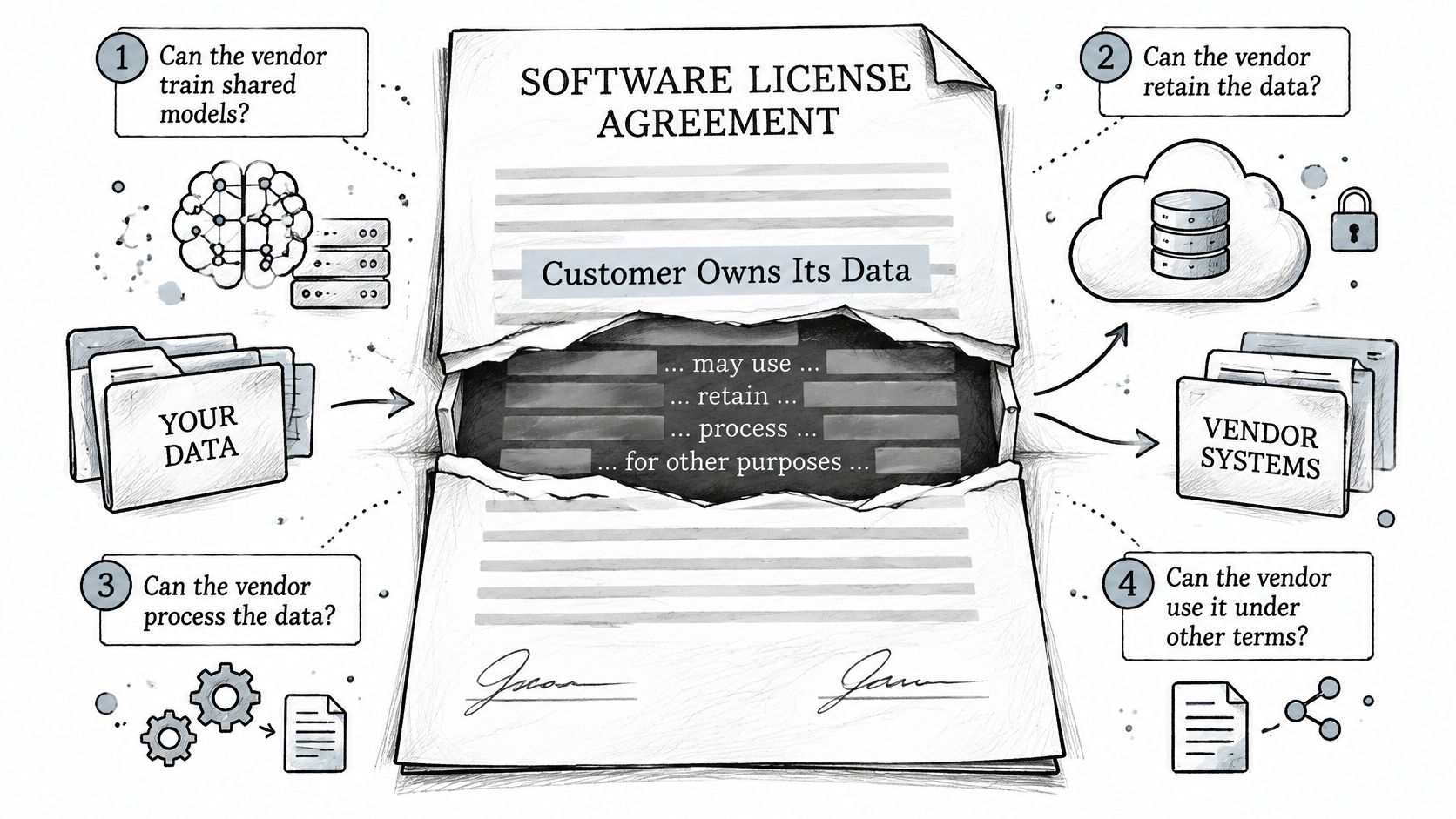
The scrutiny is warranted. The 2025 Software Supply Chain Security Report documents targeted attacks on artificial intelligence and machine learning components, while commercial black-box binaries remain difficult to inspect. A buyer who can't see inside the product needs the contract to describe what happens inside it.
Four questions belong in the vendor conversation, and each needs an answer in writing.
- Training. Can the vendor train models on customer prompts, source code or uploaded files, and is there a documented opt-out?
- Outputs. Who owns model output that resembles third-party material?
- Retention. Does the vendor keep prompts after deletion, and for how long?
- Feature drift. What happens when an AI feature is added to an existing subscription without a contract amendment?
The Rights Schedule to Attach
One page attached to the agreement answers all four. It states input and output ownership, training opt-in or opt-out, retention and deletion periods, human-review duties, a bar on using customer data to improve shared models, disclosure of subprocessors and model providers, the audit evidence the vendor will supply, incident notification timelines, and remedies if the provider changes models or materially reduces performance.
A broad clause that says the customer owns its data may be inadequate on its own, because ownership doesn't necessarily prevent processing, training, retention or disclosure elsewhere in the same document.
Say a meeting assistant arrives through a plan upgrade, records client calls and writes summaries. The vendor's standard terms allow training on submitted content. The buyer discovers it after the first recording. A signed rights schedule and a written opt-out, in hand before the upgrade goes live, separate a useful feature from a disclosure event.
Confirm These Terms Before You Sign
Seven checks settle whether the contract matches the budget. Run them the week the order form arrives.
- Match the metric to reality. Count actual users, devices and infrastructure, then confirm the full-term total rather than the year-one figure.
- Confirm the renewal date and any price change the vendor has already published, quoted with the vendor name and the date checked.
- Confirm upgrade entitlement, plus what access and data look like the morning after expiry.
- Confirm the audit mechanics. Notice period, cure period, measurement method and which records control.
- List every open-source component and write the AI data terms into a rights schedule attached to the agreement.
- Compare like-for-like units, with every price quoted alongside its vendor and the date checked.
- Put every commitment in the signed order form, not in a sales email that disappears when the account manager moves on.
The reference points behind this guide carry their own dates: U.S. Government Accountability Office, Federal Software Licenses (2014); U.S. General Services Administration, Acquisition Letter MV-2024-01 (2024); the 2022 enterprise software-audit survey; and Bitkom Research's Open Source Monitor (2025).
Price comparison only holds when the units match. Rankozo records the cheapest paid plan price word for word from each vendor's pricing page as shown to US visitors, with the date checked, and any quote put in front of a vendor should meet that bar. Rankozo's guide to cutting SaaS costs covers the renewal side of the same problem.
Take any high-value or multi-year software licensing contract to counsel before signature. The clauses are negotiable, and the three that set the price are the three worth the argument.
Pull every software agreement that renews in the next twelve months into one list, then write the metric, the renewal cap and the audit notice period next to each one. Where a metric doesn't match real usage, ask for the amendment before the notice window closes. Rankozo's price indexes are the place to check what like-for-like units cost on the day you negotiate, so the number on the order form stops being the only number you have.
Questions or corrections: editorial@rankozo.com