Guide · General
Software Pricing Models: How to Compare Real Costs
Compare software pricing models by total cost, including per-seat, usage-based, hybrid and renewal prices, with vendor prices checked in 2026.
By the Rankozo research desk · Updated November 7, 2026 · 13 min read
“Choose annual billing to save money” is incomplete advice. A discounted seat rate can still produce a larger bill when the vendor requires more seats than the team needs. The useful comparison isn't the lowest advertised monthly rate. It's the total committed cost for the people, usage and contract term the business needs.
For business owners and procurement teams, comparing software pricing models means separating the charging unit from the billing commitment. A seat, an account, a platform edition and a block of usage aren't interchangeable. Minimums, peak-seat rules and renewal clauses can change the result before anyone buys an add-on.
Table of Contents
- Software Pricing Models at a Glance
- Why the Headline Price Understates Your Bill
- Annual, Monthly and Minimum Commitments Compared
- Usage-Based Pricing and Budget Risk
- Renewal Increases Buyers Should Plan For
- How to Calculate the Total Cost of a Plan
- Pick the Model With the Lowest Three-Year Cost
Software Pricing Models at a Glance
The cheapest workable model is the one whose charging unit matches actual use, subject to the features and service the business requires. A low seat price is useful only when the required seat count is low enough, while a consumption rate is useful only when demand can be forecast and controlled.
FTI Consulting's overview of SaaS pricing distinguishes recurring subscriptions, consumption charges and outcome-linked payments from traditional perpetual licensing. Those categories describe how vendors collect revenue, not which option will cost a particular buyer less.
| Model | Charged per | Published example | Main cost risk |
|---|---|---|---|
| Perpetual license | One version, one payment | No priced vendor example established | Maintenance fees added later |
| Per-seat subscription | User or seat per month | ChatGPT Business standard seat, $25 monthly or $20 with annual billing, vendor help center, checked 2026 | Seat count grows with headcount |
| Bundled platform edition | Edition fee plus included seats | HubSpot Customer Platform higher tiers from $1,300 per month; Professional includes six paid users, vendor pricing page, checked 2026 | Extra seats beyond the allocation |
| Usage-based | Metered API calls, storage, compute or another consumption unit | No priced vendor example established | Demand spikes increase the bill |
| Hybrid platform fee plus usage | Base fee, allowance and overages | Adoption example rather than a price, 37% used a platform fee with usage included in SBI Growth's 2025 survey of 321 SaaS pricing leaders | Equal base fees can conceal different variable costs |
| Outcome-based | Achieved business result | No priced vendor example established | Disputes over measurement and attribution |
The published seat example comes from the ChatGPT Business billing help center, checked 2026; the bundled edition example comes from HubSpot's Customer Platform pricing, checked 2026. An unpriced example isn't a zero-cost option. It means a usable comparison still needs a written commercial offer.
The software and SaaS price index provides a starting point, not a complete contract total. Rankozo defines starting price as the cheapest paid plan, per user where the vendor prices per user; index prices are published in US dollars per month, with units that can differ by user, site or plan.
Comparison rule: Record the charging unit before comparing the headline price.
Why the Headline Price Understates Your Bill
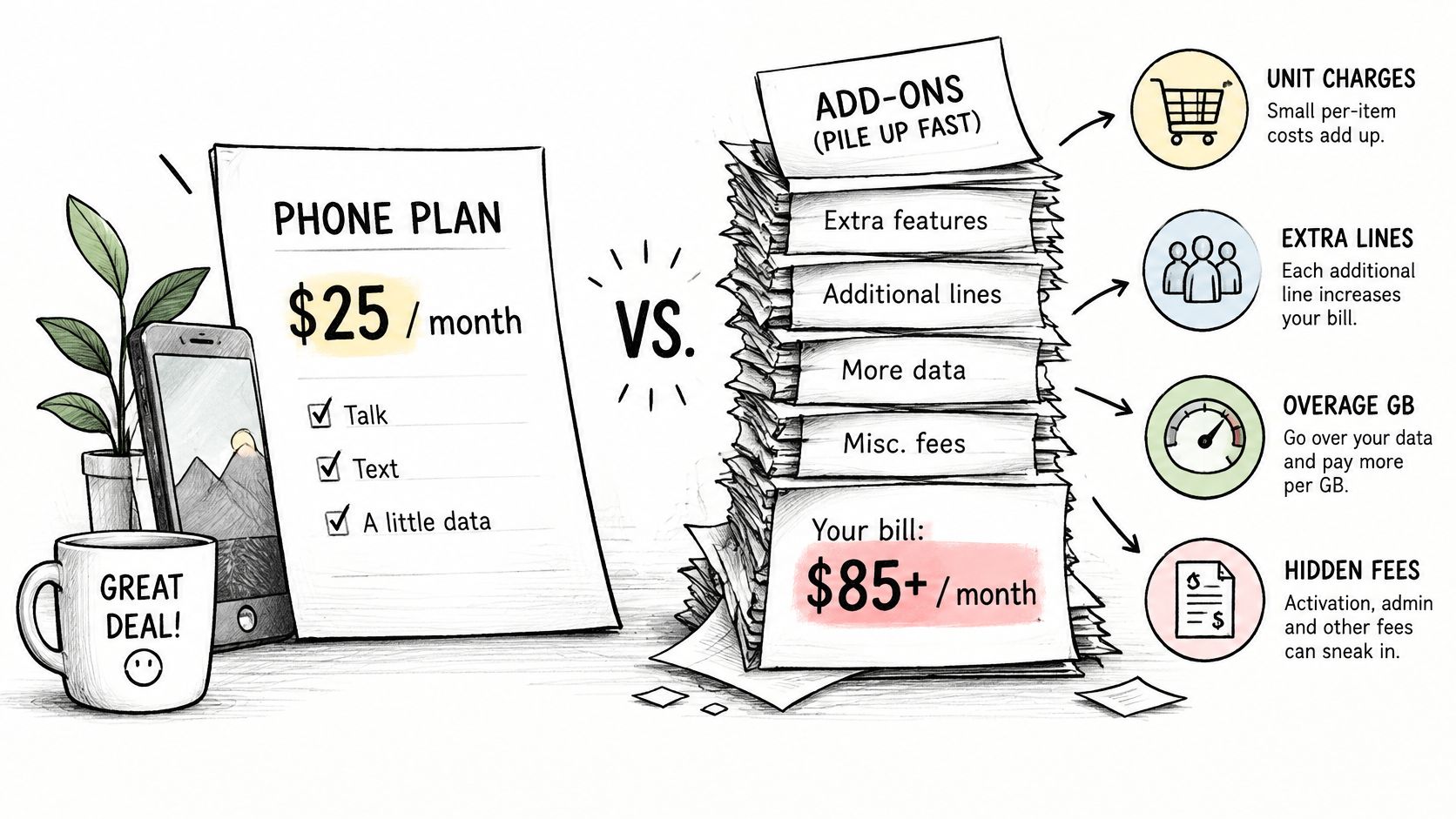
A software price page can resemble a phone contract: the advertised monthly fee covers access, but extra lines and consumption above the allowance change the invoice. The procurement task is to identify what the base payment buys and which events trigger another charge.
Units and Included Seats
Unit mismatch comes first. A hypothetical $10 per user plan and a $10 per account plan aren't the same deal. Rankozo's comparison tables are intended to compare like with like, rather than treating every monthly starting price as an equivalent purchase.
Bundled editions require a different calculation. HubSpot's Customer Platform pricing, checked 2026, lists additional Core Seats starting at $45 per month on plans that include them. Its Professional package includes six paid users, so a seventh person can introduce another charge rather than sharing the platform fee.
That distinction also affects effective cost per employee. A team below an edition's included allocation pays for the package, not just the seats it actively uses. Procurement should therefore distinguish included capacity from capacity required.
Peak Seats and Usage Credits
Atlassian's Cloud Licensing terms, checked 2026, describe Maximum Quantity Billing: monthly Jira and related cloud subscriptions use the highest number of seats assigned during the billing cycle. Added seats are prorated for the remaining period, but removing seats doesn't reduce that period's bill; those seats remain available for reassignment until the next cycle.
A temporary contractor can therefore affect the invoice even after access is removed. Counting only the employees assigned on invoice day can understate billable capacity.
ChatGPT Business adds another distinction between access and consumption. Its vendor billing guidance, checked 2026, allows workspace credits to extend usage beyond included limits. For a heavy-use team, the contracted seat payment is therefore a baseline, not necessarily the final invoice.
The practical response is to preserve the billing rule alongside the price, preferably in the purchase approval rather than a separate note that finance won't see.
- Charging unit: The exact user, account, edition or metered activity being billed.
- Included quantity: The seats, credits or consumption covered by the base payment.
- Peak rule: Whether temporary additions remain billable after removal.
- Extra-unit price: The charge triggered when included capacity is exhausted.
Annual, Monthly and Minimum Commitments Compared
The published monthly-equivalent gap is 20% for the ChatGPT Business seat types and Claude Team rates below, using vendor pricing checked in 2026. That discount compares equal seat counts. It doesn't establish that the annual purchase is cheaper when annual minimums differ.
| Vendor and plan | Monthly rate | Annual rate | Minimum or term |
|---|---|---|---|
| ChatGPT Business standard seat | $25 per user per month | $20 per user per month, billed annually | Generally at least two paid seats; vendor help center, checked 2026 |
| ChatGPT Business premium seat | $125 per user per month | $100 per user per month, billed annually | Generally at least two paid seats; vendor help center, checked 2026 |
| Claude Team seat | $25 per seat per month | $20 per seat per month, billed annually | Annual plan requires 20 seats; Anthropic, checked 2026 |
| Atlassian Jira Cloud | Progressive seat-band pricing | Advance annual purchase; obtain the applicable seat-band quote | One-month minimum service term; Atlassian, checked 2026 |
Anthropic's Team pricing, checked 2026, publishes $25 per seat per month on monthly billing and $20 per seat per month annually, with a 20-seat annual minimum. Annual subscriptions are paid upfront, so the monthly equivalent shouldn't be mistaken for a monthly payment schedule.
The Discount Has a Commitment Behind It
For an illustrative five-person team, calculations from Anthropic's checked-2026 rates produce $1,500 per year on monthly Claude Team billing, against $4,800 upfront under the annual minimum. The annual rate is lower, but the required purchase is larger.
Using the ChatGPT Business standard rates checked in 2026, the same illustrative team would commit $1,200 per year on annual billing, with its general minimum satisfied. These calculations compare billing structures, not product capabilities.
At a 20% discount, an annual commitment costs the equivalent of 9.6 months at the monthly rate, calculated with an unchanged seat count. Annual billing can therefore beat monthly billing before a full year has elapsed, but only when the required minimum and expected duration support it.
A discount on unused seats isn't a saving.
The monthly versus annual billing comparison helps frame that decision. Where vendors offer several billing options, Rankozo states which option applies. Monthly billing deserves preference when staffing or product fit remains uncertain; annual billing deserves consideration when the retained capacity will justify the commitment.
Usage-Based Pricing and Budget Risk
In 2024, nearly 73% of more than 2,000 subscription-business leaders planned to offer more usage-based pricing plans by the first quarter of 2025, according to Stripe's subscription-business survey. That was a stated plan, not proof that every respondent subsequently introduced one.
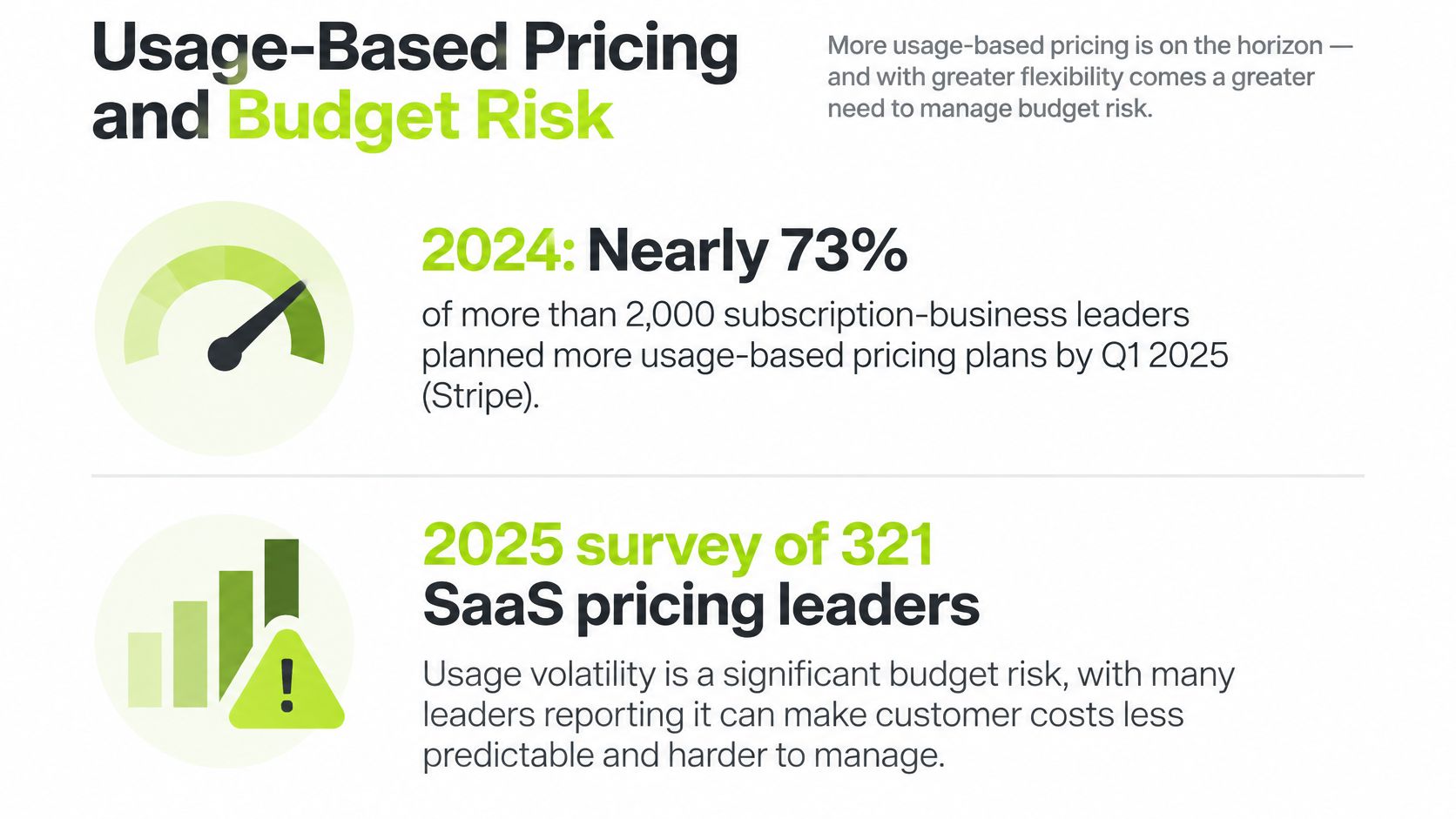
SBI Growth's 2025 survey of 321 SaaS pricing leaders found 21.2% used pure usage-based pricing, 37% used a platform fee with usage included, and 23% used flat fees with no usage included. The distinction matters because a buyer can face variable charges even when the plan begins with a predictable platform payment.
The same SBI Growth 2025 survey of 321 SaaS pricing leaders found that 66% of companies using platform-based pricing and 68% using usage-based pricing met or exceeded growth targets, compared with 55% using base-fee models and 60% using flat-fee models. These are vendor growth results, not evidence of buyer savings.
Price Demand Before Signing
A buyer should calculate consumption under distinct operating conditions rather than accepting the vendor's default calculator settings.
| Scenario | Demand assumption | Cost calculation | Buyer question |
|---|---|---|---|
| Low | Quiet operations or incomplete adoption | Contractual minimum plus billable consumption | Is unused capacity still payable? |
| Normal | Expected ongoing activity | Base fee plus consumption above the allowance | Does ordinary use fit the approved budget? |
| Peak | Campaign launch, batch processing or traffic surge | Base fee plus peak overages and required add-ons | Can the business stop or cap further charges? |
For a simple linear overage plan, the calculation is base fee plus excess usage multiplied by the overage rate, subject to the contractual minimum. Tiered rates, credit conversion and separate meters need their own lines.
A successful campaign can increase transactions, messages, or processing demand without adding employees. A seat-only forecast won't capture that exposure. Conversely, a low-use operation may avoid paying for capacity it doesn't consume.
Put Budget Controls in the Contract
Buyers should request spend caps, threshold alerts, rollover of unused credits and audit rights covering usage measurement. They should also establish whether hitting a cap stops service, restricts features or merely sends a warning.
The comparison should include the staff time needed to monitor consumption. Usage pricing can reduce idle-capacity waste while transferring forecasting and control work to the customer. Both belong in the buying decision.
Renewal Increases Buyers Should Plan For
The first-year invoice is an incomplete basis for a long-term decision. A temporary discount can make an otherwise expensive contract appear competitive, particularly when the buyer hasn't priced later seat growth or the end of promotional terms.
SBI Growth's 2025 survey of 321 SaaS pricing decision-makers.pdf) found infrastructure vendors were more likely than horizontal-software vendors to tie price increases to renewals, 35% versus 16%. It also found 55% of enterprises increased prices annually or at renewal. Those findings justify modelling renewal exposure, not assuming that a particular supplier will impose the survey's pattern.
Build a Renewal Schedule
A useful forecast separates contractual charges from assumptions. An uplift written into an order form is different from a planning allowance introduced by the buyer.
- Discount expiry: Record the undiscounted price and the exact point when it replaces the introductory rate.
- Annual uplift: Identify whether the vendor has a fixed increase, an index-linked clause or discretion to reset pricing.
- Seat commitment: Separate required seats from dormant accounts that could be removed before renewal.
- Notice deadline: Record the cancellation and automatic-renewal terms beside the renewal date.
- Added services: Include AI features, implementation, onboarding and data-export charges where applicable.
Where the contract doesn't establish an uplift, a spreadsheet should label the input assumed renewal increase, not present it as a vendor quote. With an unchanged subscription base, the model can apply the assumed increase to the next renewal and compound it at the following renewal.
Negotiation priority: Limit the vendor's ability to change the payable total, not just the advertised unit rate.
Negotiate the Exit as Well as the Price
Procurement should request a renewal cap, grandfathered pricing where available, a written notice period, downgrade rights and an itemized invoice. A cap without downgrade rights can still leave the business paying for excess seats.
Vendors change prices often, and several have announced increases taking effect after November 4, 2026. Those announced changes should be treated as future effective prices rather than substituted for the price available on the checking date.
A higher initial offer with enforceable renewal protection can cost less over the contract horizon. The comparison must calculate that possibility rather than assume the cheapest opening offer remains cheapest.
How to Calculate the Total Cost of a Plan
A spreadsheet should separate published rates, contract terms and buyer assumptions. Combining them into an unexplained annual estimate makes it harder to identify what finance can verify and what procurement can negotiate.
The Calculation Routine
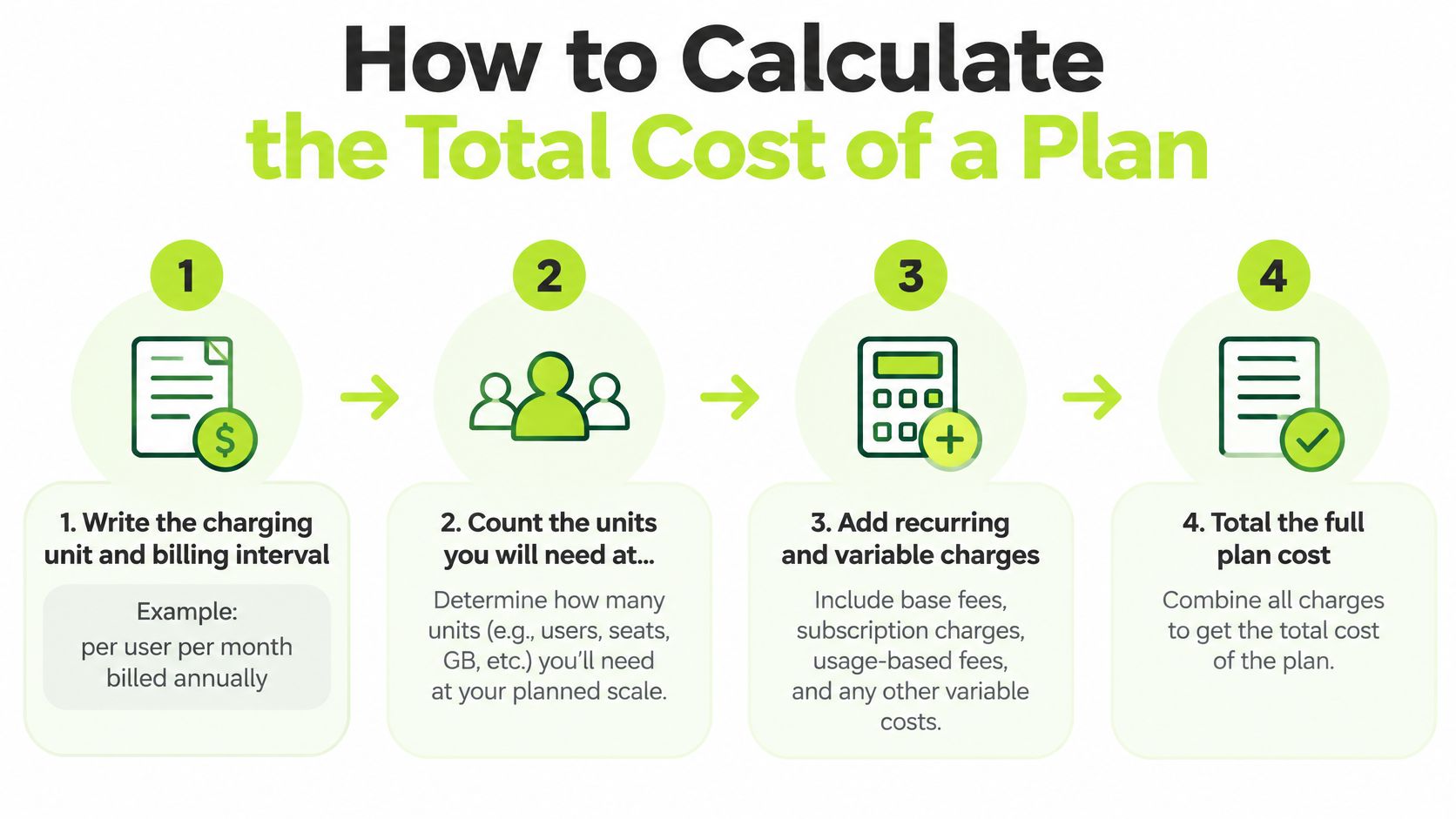
Write the charging unit and billing interval. Record wording such as per user per month, billed annually, so the rate and payment obligation remain distinct. Common slip: treating a monthly equivalent as a cancellable monthly subscription.
Count realistic billable units. Use the expected staffing schedule, contractor access and demand pattern rather than today's headcount alone. Common slip: overlooking a peak-seat rule when modelling temporary access.
Multiply the applicable units by the published rate and billing period. Use the annual rate only where the business will accept the annual commitment. Common slip: applying an annual discount to a monthly purchase.
Apply minimum commitments before calculating savings. Anthropic's Team terms, checked 2026, require the annual purchase to cover its published minimum even when the business needs fewer seats. Common slip: multiplying only by the employees who will use the software.
Add extra-seat charges and consumption above included allowances. Keep each meter separate when the vendor charges differently for storage, processing or credits. Common slip: assuming included usage applies equally to every feature.
Include implementation, onboarding, migration and exit costs where quoted. A perpetual license needs its one-time purchase plus maintenance for each year; unavailable maintenance pricing should be recorded as ?, not estimated. Common slip: treating the purchase price as the complete ownership cost.
Repeat the unit and recurring-charge calculations for subsequent renewals. Apply contractual changes separately from labelled planning assumptions, then total the full comparison period. Common slip: copying the opening-year invoice forward unchanged.
Worked Commitment Check for a Five-Person Team
The following calculations use the vendor rates checked in 2026 and assume unchanged prices, continuous service and no taxes, credits, add-ons or implementation fees.
| Vendor and billing option | Annual cost calculation | Three-year total before uplift |
|---|---|---|
| Claude Team annual | 20-seat minimum × $20 × 12 = $4,800, paid upfront annually | $14,400 |
| Claude Team monthly | 5 seats × $25 × 12 = $1,500 | $4,500 |
| ChatGPT Business standard annual | 5 seats × $20 × 12 = $1,200 | $3,600 |
| ChatGPT Business standard monthly | 5 seats × $25 × 12 = $1,500 | $4,500 |
These are arithmetic scenarios based on Anthropic's Team pricing and the ChatGPT Business billing guidance, both checked in 2026, rather than guaranteed future invoices. They show why the minimum purchase must enter the calculation before the discount.
The single comparison number is the three-year total for a workable configuration. A missing mandatory charge means that total remains incomplete, even when every visible line has been calculated correctly.
Pick the Model With the Lowest Three-Year Cost
| Usage pattern | Model that usually fits | Check before signing |
|---|---|---|
| Fixed headcount, steady use | Per-seat subscription | Annual rate and seat minimum |
| Growing team with add-ons | Bundled platform edition | Included seats and extra-seat price |
| Spiky traffic or API calls | Usage-based with cap | Overage rate, spend cap and alerts |
| Predictable base plus variable volume | Hybrid platform fee | Included allowance and rollover rules |
| Stable tool kept for years | Annual billing | Break-even against monthly billing |
These are starting hypotheses, not automatic recommendations. The workable plan must include required features, security and service commitments before procurement compares cost. A cheaper configuration that omits a required capability isn't a substitute.
Annual billing is a commitment choice rather than a separate charging unit. A vendor can combine it with seats, editions or consumption minimums, so the decision table shouldn't be read as a set of mutually exclusive categories.
Make the Shortlist Comparable
A buyer can complete the comparison this week by placing the shortlisted tools in a shared spreadsheet. Each row should identify the vendor, plan, check date, charging unit, included quantity, minimum commitment, peak rule and renewal uplift.
- Normalize the requirement: Give each vendor the same staffing and usage assumptions.
- Separate evidence from estimates: Mark published charges, negotiated terms and planning inputs distinctly.
- Resolve missing prices: Obtain a written quote rather than filling gaps with a competitor's rate.
- Compare payable totals: Include the cost of required extras and retain a peak-demand scenario beside the expected total.
Tools whose vendors publish no prices are listed without a starting price, with the vendor quoting each package. An unpriced option should remain unpriced until a usable quote arrives; it shouldn't receive an invented number merely to complete a ranking.
The guide to cutting SaaS costs provides a useful next step once the comparison identifies excess capacity or avoidable commitments. Savings should come from a configuration the business can operate, not from assuming away necessary users or consumption.
Choose the lower defensible total, not the lower-looking price.
Published prices can change. The buyer should confirm each rate on the vendor's own page on the purchase date and record the vendor and check date beside it.
This week, procurement should take its shortlisted tools, complete the cost calculation and obtain written answers for every unpriced mandatory charge. Rankozo's published prices can support the initial shortlist; the final approval should identify the lowest workable three-year total, the assumptions behind it and the person responsible for the renewal deadline.
Questions or corrections: editorial@rankozo.com