Guide · General
How Much Do Audiobooks Cost in 2026? Prices Compared
How much do audiobooks cost in 2026? Free library loans, Audible and Spotify memberships and per-title prices, with vendor names and check dates.
By the Rankozo research desk · Updated November 27, 2026 · 13 min read
A public library loan costs $0 with a participating library card, and the lowest paid membership in this comparison is Audible Standard at $8.99 a month (2025, Audible) after a 30-day trial. The price of buying one title outright varies by store and edition, so buyers must check the retailer's page directly before paying.
A lower monthly subscription fee doesn't guarantee a lower cost per book. A listener paying a modest recurring fee who only finishes one long novel every two months can easily spend more per completed title than someone who buys individual books outright or borrows through a local library system.
When readers ask how much do audiobooks cost, most store pages answer with a promotional monthly number instead of the actual bill per finished book. Measuring the true price requires comparing free library loans, single-title purchase benchmarks, listening-hour caps, credit rules, and unused billing cycles side by side.
Table of Contents
- Audiobook Prices at a Glance
- What One Purchased Audiobook Costs
- Allowances, Credits and Break-Even Math
- Trial Terms, Renewals and Regional Prices to Check
- How Listeners Combine Free, Paid and Subscription Access
- Choose the Cheapest Audiobook Option for Your Listening Pace
Audiobook Prices at a Glance
The cheapest workable way to listen to audiobooks costs $0. According to AudioPage's audiobook subscription comparison checked on September 20, 2026, Libby lets readers borrow digital audiobooks at no charge with a participating library card. The trade-off is temporary access instead of ownership, because borrowed titles come with due dates, potential waitlists on popular releases, and catalogs limited to each library system's holdings.
Paid access splits into monthly memberships, streaming add-ons, credit plans, and individual store purchases. The table below compares published US prices, what each route provides, and the primary limitation attached to every option.
Audiobook prices by access model
| Access model | Typical US price | What you get | Main catch |
|---|---|---|---|
| Public library loan (Libby) | $0 with a participating library card (AudioPage, September 20, 2026) | Borrowed titles returned by a due date | Waitlists and a catalog limited to the library's collection |
| Audible Standard membership | $8.99 per month (2025, Audible) | Monthly membership after a 30-day trial | Price shown is the 2025 figure, so check the current page |
| Spotify Audiobooks+ add-on | $11.99 per month on top of Premium (2025, Spotify) | Audiobook listening added to an existing Premium plan | Requires Premium and has a monthly listening allowance |
| Audible Premium | $14.95 per month (The Pricer, October 2026) | One credit redeems one eligible title, regardless of length | Credits are limited to eligible titles and the monthly plan |
| Single title purchase | No fixed US rate; check the store page | Permanent ownership of that title | Full price is paid for every title bought |
Reading Annual Totals and Price Check Dates
Monthly fees look small until they're annualized. Before comparing plans, multiply each published monthly rate by 12 to see the full yearly commitment for Audible Standard at its 2025 rate, the Spotify Audiobooks+ add-on at its 2025 US rate of $11.99 per month (before counting the required Premium plan underneath it), and Audible Premium at its October 2026 rate.
A lower monthly fee isn't automatically the cheapest route per book. Different vendors sell different units, so a capped listening allowance, a single-title credit, and an add-on fee don't buy the same amount of finished listening.
Check the date printed beside every price before acting on it. Rankozo quotes published figures from vendor pages on the date checked and leaves unverified prices open rather than guessing. Because the Audible Standard price reflects 2025 and the Audible Premium price reflects October 2026, those two rows don't come from the same pricing snapshot. Single-title US retail rates aren't fixed across stores either, which is why that row stays open until a buyer checks the exact book page.
What One Purchased Audiobook Costs
A reader looking up a newly released nonfiction book that isn't available through a local library card faces a price problem: no single verified US retail rate exists across stores for an individual audiobook. Analysts therefore turn to audited buyer-spending data from a neighboring English-language market as a historical benchmark.
In Canada, the average price paid for an audiobook by buyers of new books was C$15.64 in 2023, according to BookNet Canada's Canadian Book Consumer Study. That study also recorded an 11% increase in audiobook prices between 2019 and 2023. Over the same 2023 snapshot, Canadian book buyers paid an average of C$24.04 for hardcovers, C$17.72 for paperbacks, and C$12.61 for ebooks.
Those figures capture actual consumer spending in Canadian dollars rather than a US store price, so they can't serve as a US retail quote. The format hierarchy still reads clearly: purchased audiobooks averaged less than print editions while costing more than ebooks.
Why Single Audio Titles Cost More Than Ebooks
Production labor sets a real cost floor under retail audio pricing. According to The Collingwood Press's per-finished-hour cost breakdown, a standard planning benchmark is roughly $200 per finished hour (PFH) for narration plus about $200 PFH for editing, quality control, mixing, and mastering, which puts complete professional production at roughly $400 PFH. Using the industry conversion of about 9,300 words per finished hour, an 80,000-word book runs approximately 8.6 finished hours, so the production bill comes to roughly $3,400 before distribution or marketing.
That production floor explains the retail gap. An ebook carries editing and formatting costs but skips the studio time entirely, while a printed paperback spreads printing and shipping over large runs. An audio edition must recover per-hour narration and post-production labor on every title regardless of sales volume, so a single copy priced near a paperback would rarely cover the recording cost.
Because single-title retail prices shift by title length, store, edition, and temporary promotions, buyers should verify the exact price before choosing between buying and subscribing:
- Open the exact product page: Confirm the edition, narrator, and unabridged runtime on the specific store where you intend to buy.
- Log the price and date: Record both the listed US dollar price and the day you checked it, since digital storefronts run short-term discounts and adjust catalog pricing.
- Compare against alternative access: Measure that single-title price against a $0 library hold and the effective per-book subscription math before clicking purchase.
Permanent ownership is the main financial advantage of buying outright. Paying once makes sense for a reference title, a favorite novel you plan to revisit, or a release your public library doesn't carry.
Allowances, Credits and Break-Even Math
A credit plan and an hourly allowance create different costs for the same finished audiobook. The useful budgeting figure is the effective cost per finished title: monthly fee divided by titles finished in the month.
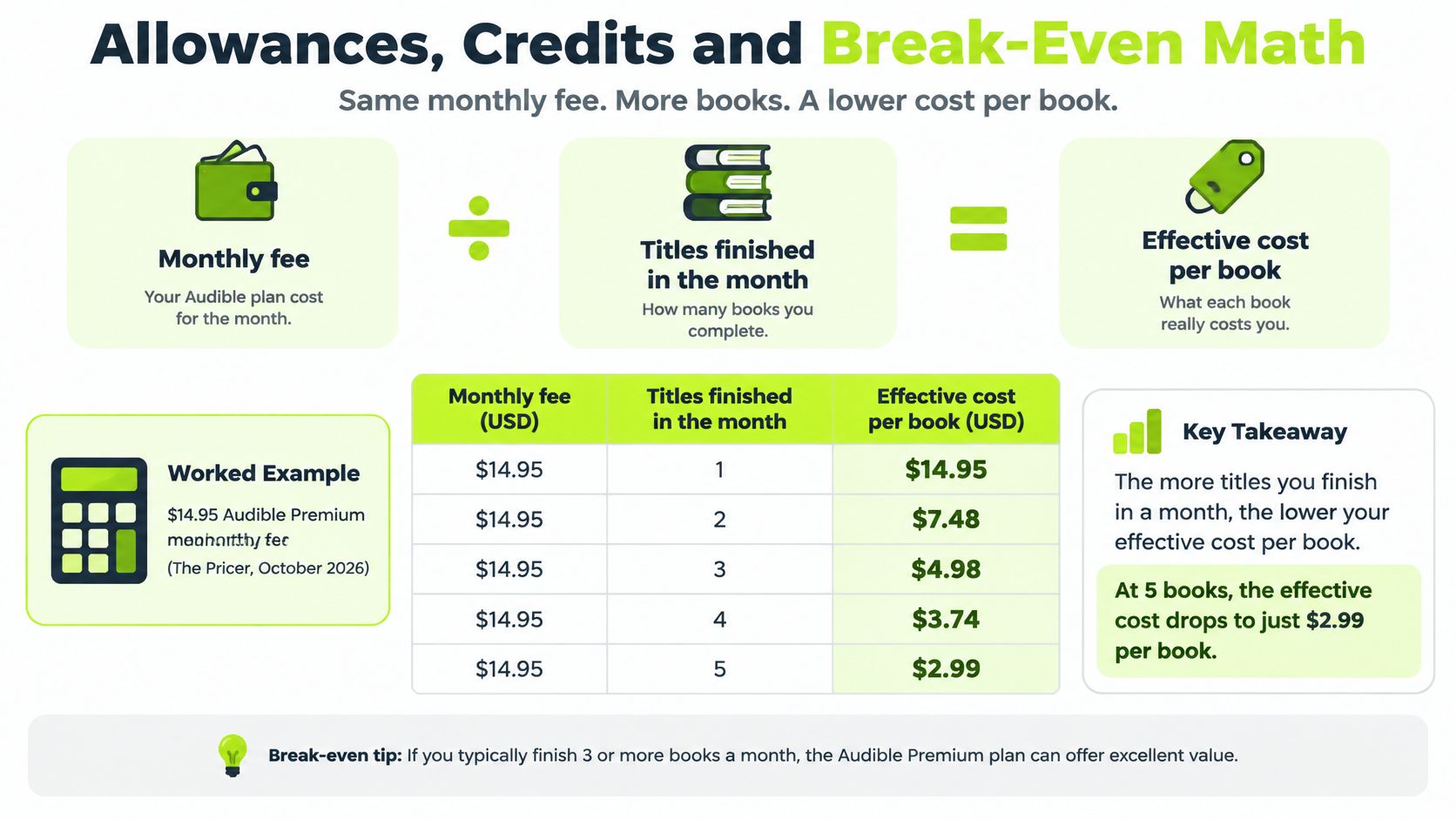
Take Audible Premium at $14.95 per month as of October 2026, as reported by The Pricer's Audible pricing breakdown. Finishing one title in a billing month puts the cost at $14.95 per book. Finishing two titles drops it to $7.48 per book, and finishing three titles brings it down to $4.98 per book.
Audible Standard's published 2025 rate of $8.99 per month works out to $8.99 per book at one title, $4.50 per book at two titles, and $3.00 per book at three titles. Those figures assume the listener finishes multiple eligible titles inside the plan instead of paying extra or letting unused benefits expire.
Listening Hours Versus Book Credits
Book length changes the comparison because platforms meter access differently. A credit buys an eligible title, while a capped listening allowance measures time inside a billing cycle.
For a 22-hour audiobook, Audible Premium's single-credit model is the cleaner comparison. One credit ordinarily covers the full eligible title because the unit is the book, not a fixed block of hours. That avoids splitting one novel across billing months, which can raise the effective cost of finishing it.
Credits still carry limits. They apply to eligible titles in the platform's store, and unused credits can expire under plan rules. A listener who finishes one eligible title each month gets predictable value. A listener who saves credits for expensive titles, then lets them lapse, pays the membership fee without reducing the purchase bill.
Calculating Your Personal Break-Even Point
To test whether a paid membership beats buying books one by one, divide the monthly membership fee by the single-title store price checked on the day of the decision.
Say that division yields 2.4. A listener who consistently finishes three titles a month comes out ahead with the subscription. A listener who finishes two titles a month pays less by purchasing individual books or using library loans.
Unused time is the hidden cost multiplier across recurring digital plans, a pattern visible throughout broader subscription economy statistics. Letting a membership sit unused for half a month, or finishing one book across two consecutive paid cycles, doubles the cost of every completed title.
Annual reality check: Multiply the monthly membership fee by 12 and divide that yearly total by the number of audiobooks you genuinely finished over the past year, not the number you hope to finish next month.
Trial Terms, Renewals and Regional Prices to Check
A low advertised monthly fee rarely tells the full billing story. Trial transitions, required base plans, regional currencies, and credit expiration rules regularly push a subscriber's actual bank statement above the promotional banner.
Look at how introductory terms convert into recurring bills. According to Audible's member benefits page, Audible's US Standard membership cost $8.99 per month after a 30-day trial in 2025. That means the first charge lands automatically once the 30-day trial closes, and only cancelling before the renewal date prevents billing.
Stacked pricing catches subscribers off guard just as often. An audiobook add-on doesn't function as a standalone plan when a vendor requires an active base tier underneath it. A Spotify subscriber adding an audiobook tier pays both the underlying Premium subscription and the add-on fee every billing cycle. Because the published prices for base plans and add-ons aren't always updated on the same date, subscribers should pull both current rates from the vendor's checkout page on the exact same day before adding them together.
Geographic boundaries shift the math further. All membership prices in this guide are quoted in US dollars, while catalog licensing, monthly fees, and library lending rights change by country and municipality. A US library system's digital holdings on Libby won't match a neighboring county's catalog, and international storefronts price memberships in local currencies under separate terms.
Pre-Signup Verification Checklist
Before entering payment details for any audiobook trial or recurring membership, verify five specific terms directly on the checkout screen:
- Trial length: Confirm the exact number of free days and whether full catalog features or credits activate immediately during the trial window.
- Renewal date: Mark the calendar date at least 48 hours before automatic billing begins so an unwanted renewal doesn't post.
- Add-on requirement: Check whether the listed audiobook price stands alone or requires a separate active music or retail membership underneath it.
- Currency and local catalog: Verify that the checkout screen displays your local currency and that the specific authors or publishers you want are licensed in your region.
- Credit rollover and billing cycle: Read whether unused monthly credits carry over to the next cycle or expire, and compare monthly billing against annual billing only after confirming the non-promotional renewal price.
Never evaluate a subscription from a promotional headline before reading the regular renewal rate, the currency, and the credit rollover clause on the checkout page.
How Listeners Combine Free, Paid and Subscription Access
US audiobook sales reached $2.43 billion in 2025, up 9% from the year before, and 58% of US adults (about 157 million people) had listened to an audiobook at least once, according to Publishers Weekly's 2025 US audiobook market report.
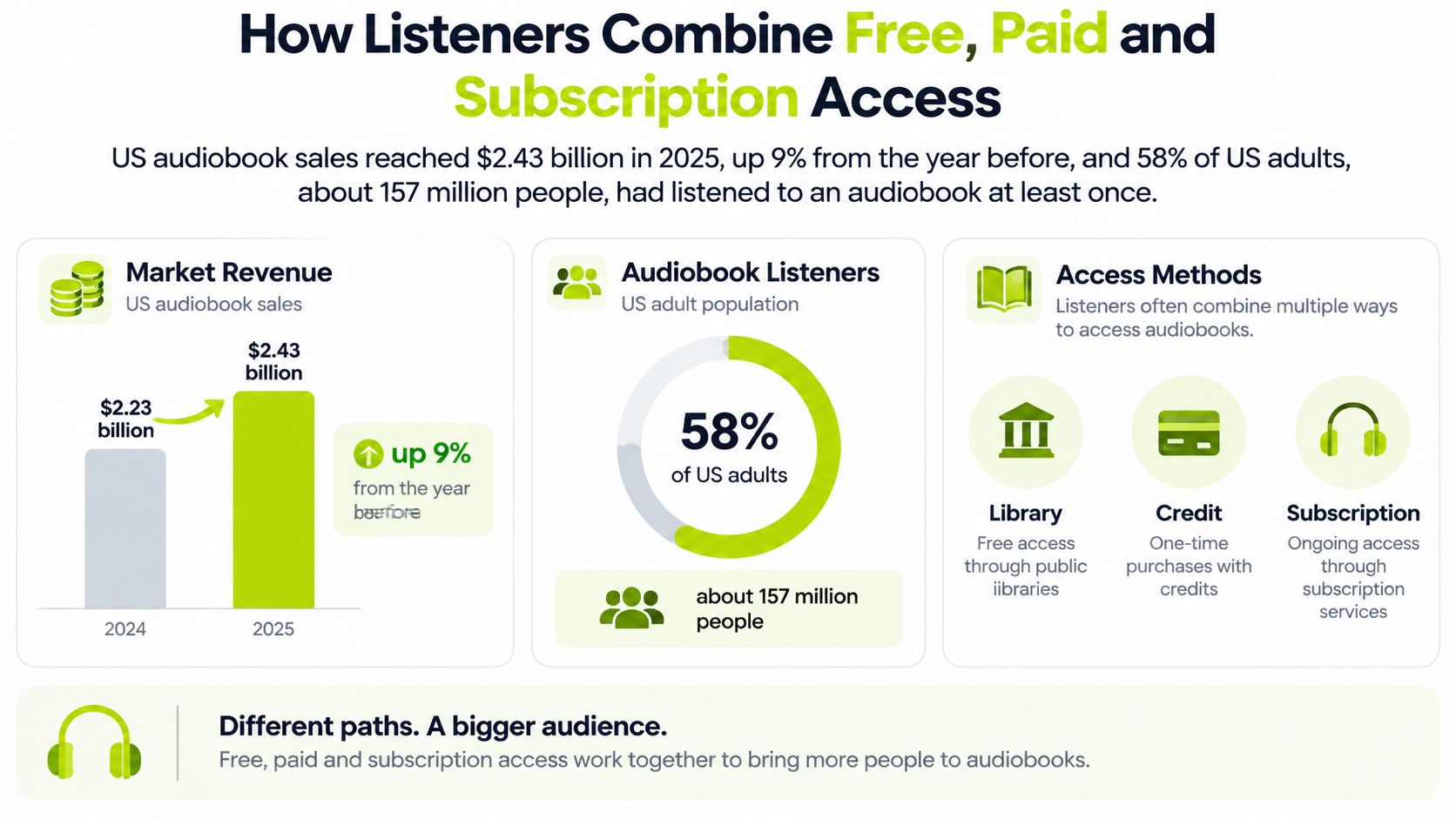
Most listeners don't rely on a single pricing model. Recent US consumer data cited in that same Publishers Weekly report shows heavy overlap across four distinct channels.
Share of US audiobook listeners by access channel
| Access channel | Share of US listeners | Primary payment model |
|---|---|---|
| Direct purchase from websites or apps | 49% | Per-title retail payment |
| Subscription service | 48% | Recurring monthly fee |
| Digital library app | 46% | Free loan with library card |
| Credits from a dedicated audiobook service | 42% | Monthly or bundled credit redemption |
Why Channel Shares Exceed 100 Percent
Adding the four percentages in the table pushes the total well past 100%, because listeners routinely mix channels rather than locking themselves into one storefront. A practical budget rarely treats audiobooks as an all-or-nothing choice.
The most common hybrid pattern assigns each channel a clear job. A public library card handles back-catalog titles and casual listening at zero cost, direct retail purchases cover specific releases or favorite rereads the library doesn't stock, and a paid membership absorbs steady, high-volume monthly listening.
That multi-channel behavior mirrors broader household media spending tracked in streaming price statistics, where consumers combine free ad-supported or public options with paid tiers as recurring rates climb. International publishing figures confirm the same multi-channel shift: the UK audiobook market reached a record £268 million in publisher revenue in 2024, up 31% from roughly £206 million in 2023 while overall UK publishing grew just 1%, according to the Publishers Association. Revenue expanded across single purchases, subscriptions, and platform agreements alike.
Placing your own listening habits into that pattern takes two quick questions: which upcoming books on your reading list are missing from your library's digital catalog, and how many of those missing books will you realistically finish in a normal month? Title availability drives total annual spending just as heavily as monthly fees, meaning a low recurring subscription still turns out more expensive for a listener who completes only a few eligible titles a year.
Choose the Cheapest Audiobook Option for Your Listening Pace
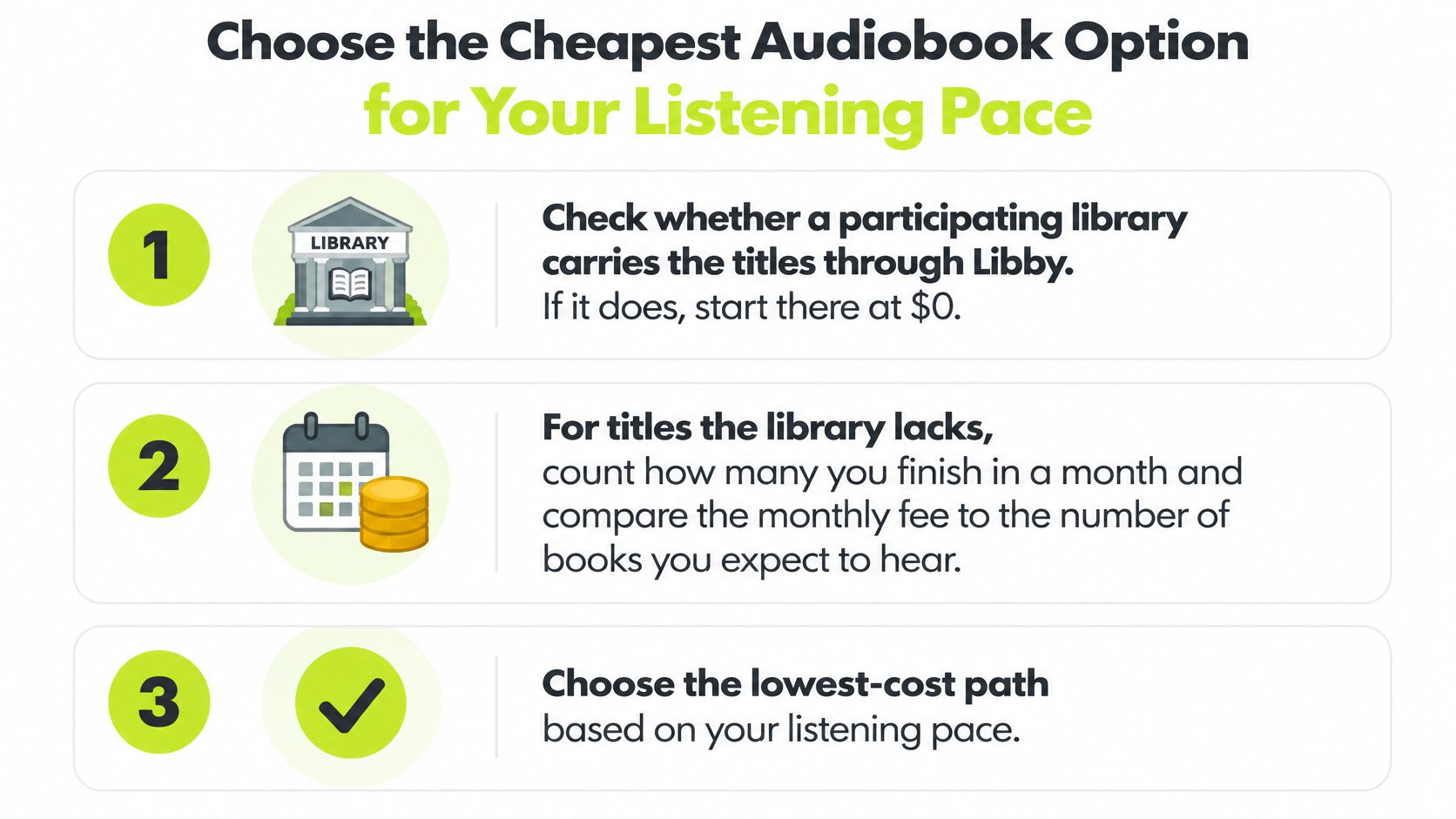
Picking the lowest-cost listening setup comes down to matching the payment structure to real completion habits rather than chasing the lowest advertised monthly fee. Follow the decision path below in strict order so free options eliminate unnecessary spending before any recurring bill starts.
Six Steps to Match Your Model to Your Pace
- Search your participating library on Libby first: Enter the next five titles on your reading list into your local library's digital app. Every title you can borrow there brings your direct cost to $0, immediately shrinking the pool of books you ever need to pay for.
- Count your real monthly completions outside the library: Look back over the last two or three months and count only the non-library titles you finished from start to end. Unfinished books don't count toward value, because half-listened titles inflate the effective price of every book you complete.
- Run the break-even calculation with today's store prices: Check the current US purchase price for two or three typical titles you want to buy, then divide your target subscription's current monthly fee by that single-title price to find your personal break-even volume.
- Subscribe only when pace and book length align: A paid membership wins only when your monthly completion count exceeds your break-even threshold and the plan's unit of value matches your reading taste. Listeners who prefer long 20-hour epics need credit-based plans rather than tight monthly hour caps; comparing plan structures across the best audiobook apps helps separate credit models from capped streaming tiers before signing up.
- Buy single titles when your pace sits below break-even: If you finish fewer than one or two non-library audiobooks per month, paying full retail price occasionally (or waiting for store sales while keeping library holds active) beats paying 12 consecutive monthly fees for unused credits or expired hours.
- Start on monthly billing for three months before going annual: Annual subscriptions sometimes reduce the effective monthly rate, yet locking in 12 months up front backfires if your listening drops in month four. Pay monthly for 90 days while logging completions, then switch to annual billing only if the full-year total saves money and your pace holds steady.
The 60-Day Cost Audit
Before activating any paid tier, run through the pre-signup verification checks: confirm the trial window, calendar the renewal date, verify whether a base subscription is required underneath an add-on, check the currency, and read the credit rollover policy.
Once your chosen model is active, run a strict 60-day cost audit. Log every audiobook you finish over those two billing cycles alongside every dollar spent across memberships, add-ons, and one-off store purchases. Divide your 60-day total spend by the number of finished titles, then compare that real per-book cost against your break-even threshold.
Two months of honest tracking reveals more about real listening costs than any plan comparison chart.
If your effective cost per book lands above what single purchases or library holds would have cost, cancel before month three renews and revert to a library-first hybrid setup.
Start your own listening audit today before another recurring charge posts. Check your next five titles on your local library's Libby catalog at $0, record the current store prices for whatever is missing, and log every completed book for the next 60 days. When you're ready to compare verified starting prices, credit mechanics, and renewal terms across platforms side by side, review Rankozo's published pricing guides and audiobook app comparisons before committing to an annual plan.
Questions or corrections: editorial@rankozo.com