Guide · General
AI Pricing Models: Seats, Usage, Credits and Outcomes
AI pricing models compared: seat, usage, credit and outcome pricing, with dated vendor prices, hidden costs and how to estimate your monthly bill.
By the Rankozo research desk · Updated November 8, 2026 · 12 min read
Choosing the lowest monthly fee is poor advice for comparing AI pricing models. The cheapest workable option is the plan that covers a defined workload at an acceptable quality level, without leaving the buyer exposed to uncontrolled overages. That requires comparing billable volume multiplied by the applicable rate, not subscription prices alone.
A seat buys access. A token buys processing. A credit buys whatever work the vendor assigns to that credit. Those aren't interchangeable units, and the differences become expensive when a pilot turns into a production workflow.
Table of Contents
- The Six AI Pricing Models at a Glance
- How Seat and Subscription Plans Charge
- How Usage and Credit Plans Meter Your Work
- Why the Same Workload Can Cost Two Amounts
- Matching a Pricing Model to Your Usage Pattern
- Budgeting Pilot Bills and Choosing a Plan
The Six AI Pricing Models at a Glance
| Model | What you pay for | Unit you usually see | Cost predictability |
|---|---|---|---|
| Seat-based subscription | Access for each named user | Per user per month | High, rises with headcount |
| Capacity commitment | Reserved processing or usage volume | Monthly or annual fee for a committed level | High while usage stays inside the commitment |
| Usage-based metering | Tokens, requests or compute consumed | Price per million tokens or per call | Low, moves with volume and prompt length |
| Credit-based plan | Prepaid units spent on each feature | Credits per month or per credit pack | Medium, governed by credit burn per action |
| Output-based pricing | Completed AI work products | Price per summary, draft or record updated | Medium, governed by the definition of an output |
| Outcome-based pricing | Business result delivered | Price per resolved ticket or recovered amount | Variable, governed by result attribution |
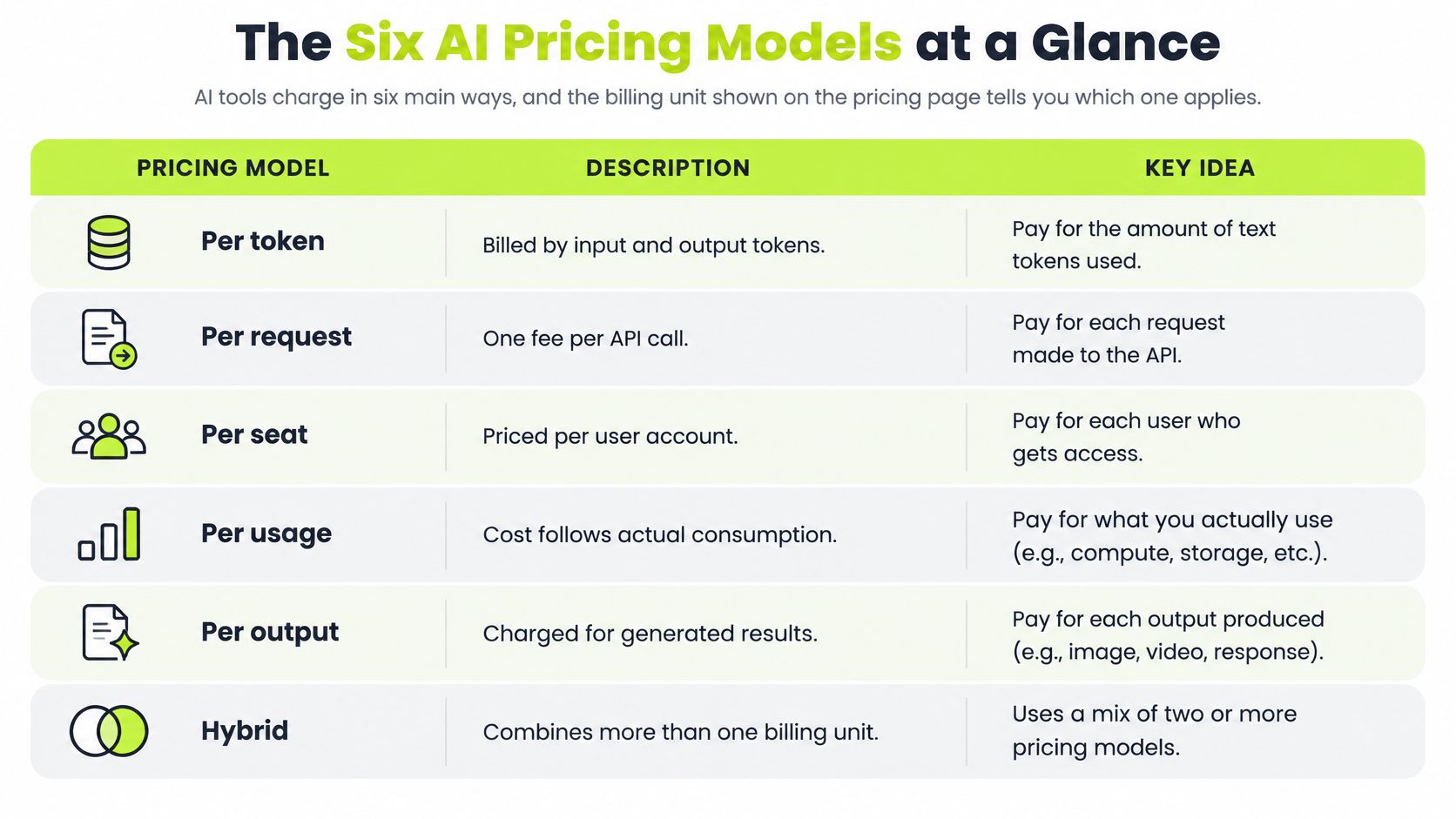
AI tools charge in these six main ways, and the billing unit on the pricing page identifies the structure. A product can combine them, so a subscription doesn't necessarily mean a fixed total bill.
The 2026 Bain analysis of AI pricing found that approximately 80% of vendors introducing AI pricing used capacity-based models, while about one in five AI-native software companies still relied mainly on per-seat licensing. Those findings concern different groups, so they shouldn't be treated as complementary shares of one market.
Access, resources and results are different purchases
Seats monetize access for people. Capacity commitments monetize reserved availability, whether expressed as processing capacity or a defined usage allowance. Usage-based charges measure resources consumed.
Credits belong inside that metering category rather than representing a separate economic principle. They replace technical units with a prepaid balance, but the buyer still needs to translate an action into consumption.
Outputs and outcomes move the charge closer to the buyer's objective. A generated summary is an output; a customer issue successfully resolved is an outcome. Producing something and delivering a business result aren't the same event.
The visual groups familiar pricing-page labels, including hybrid arrangements that combine billing units.
Read the meter before the price
The commercial distinction matters more than the label a vendor gives its plan. An apparently inexpensive seat can include an allowance and then generate separate charges for tokens, credits or agent execution.
Practical rule: Identify what causes the next charge before comparing the size of that charge.
The AI tool pricing statistics provide context for comparing published pricing structures. For an individual purchase, the essential task is narrower: identify the base fee, the included entitlement and the unit billed after that entitlement runs out.
How Seat and Subscription Plans Charge
A seat plan works like a gym membership paid per person. A capacity commitment works more like reserving a block of hotel rooms: the reservation costs money even when some rooms remain empty.
Neither structure is cheaper by nature. The seat plan suits a buyer budgeting access for identified employees; the capacity plan suits a buyer reserving processing for a workload.
A user price isn't an account price
Consider a hypothetical plan priced at $10 per user per month, compared with another priced at $10 per account per month. A team with five billable seats would pay $50 monthly under the first arrangement, while a team with twenty would pay $200. The account-priced option would remain $10 only if its terms covered that team without additional user charges.
These are illustrative calculations, not vendor quotes. They show why a price comparison must preserve the billing unit rather than strip every offer down to a dollar amount.
In Rankozo's price index, starting price means the cheapest paid plan, per user where the vendor prices per user. That convention supports like-for-like comparisons, but it doesn't turn an entry-level plan into a complete team budget.
Annual billing needs the same care. When a vendor offers a discount for an annual commitment, the buyer should compare the full commitment against the expected period of use, not mistake a monthly equivalent for a cancellable monthly payment.
What the subscription actually includes
A subscription can bundle model access, a request allowance or a pool of credits. The base fee may cover routine use while leaving heavier processing outside the bundle.
The depletion rule matters. After an allowance runs out, the service might pause, restrict access, require a top-up or continue charging. Procurement should record the actual rule instead of assuming that a recurring fee means unlimited work.
A predictable access fee isn't necessarily a predictable operating bill.
The final subscription review should cover these checks:
- Billing unit: Establish whether the advertised amount applies to a person, account or committed capacity level.
- Included allowance: Record the eligible models, features and usage entitlement, including whether allowances are shared or assigned individually.
- Price after the first term: Separate introductory pricing from renewal pricing, and distinguish an annual commitment from month-to-month billing.
That review also exposes unused seats and overlapping entitlements before they become recurring expenses.
How Usage and Credit Plans Meter Your Work
Usage pricing works like a taxi meter. A short journey can look inexpensive until traffic adds time; an AI request can look inexpensive until a long document, extended response or repeated execution adds billable work.
A token is a unit of text that a model processes, which can be a word, part of a word or punctuation. Request count establishes how often processing occurs, while prompt length and generated-response length establish how much text each request processes. Two applications can place the same number of requests and produce very different bills.
Translate actions into billable consumption
An application-level action isn't necessarily a billable API request. A document-processing action might involve extraction, classification and validation, each requiring separate processing.
A useful usage ledger therefore records the customer-facing action alongside the underlying calls. Without that mapping, a procurement team can forecast document volume correctly and still underestimate the API bill.
Credit plans introduce another translation. A monthly grant or purchased pack provides a balance, and each feature deducts credits according to its assigned cost. The relevant comparison is credits consumed per completed action, not the balance printed beside the subscription price. A cheap monthly fee paired with a fast-burning balance can cost more in practice than a pricier plan whose credits stretch further.
Credit rules also need a separate operational review:
- Burn rate: Identify the credit deduction for each feature and model.
- Balance treatment: Establish whether purchased and included credits expire or roll over.
- Depletion behavior: Confirm whether processing stops or automatic purchases continue.
Prepaid spending can also set throughput limits
The Perplexity API rate-limits and usage-tier policy sets cumulative API-credit purchase thresholds of $0, $50, $250, $500, $1,000 and $5,000 for Tiers 0 through 5, respectively. The policy states that higher tiers increase request and token limits and that an account retains a tier once reached.
Perplexity API usage tiers by cumulative credits purchased
| Tier | Cumulative API credits purchased | What the tier provides |
|---|---|---|
| Tier 0 | $0 | Starting tier for new accounts |
| Tier 1 | $50 | Higher request and token limits than Tier 0 |
| Tier 2 | $250 | Higher request and token limits, kept once reached |
| Tier 3 | $500 | Further increases in request and token limits |
| Tier 4 | $1,000 | Further increases in request and token limits |
| Tier 5 | $5,000 | Highest tier in the published policy |
Under this structure, prepaid spending does more than purchase consumption: it provides capacity. A buyer may hold enough credit to fund a workload yet still hit a ceiling when requests arrive in bursts, because the account's tier governs how quickly the work can run. The cheapest purchase path on paper can therefore delay production output.
For a usage forecast, monthly volume should be multiplied by the applicable rate for each unit. Any overage schedule then needs a separate calculation, because the rate advertised at entry may not govern consumption beyond an allowance.
Why the Same Workload Can Cost Two Amounts
A model can post one headline input rate and still bill two different totals for the same request. The bill is a function of volume and the unit definition: how many tokens move in each direction, which side of the request they sit on, and which rate period applies.
Assume an illustrative monthly workload of one million input tokens and 200,000 output tokens, with output including any billable thinking tokens. The example isolates token charges and does not represent a complete application budget.
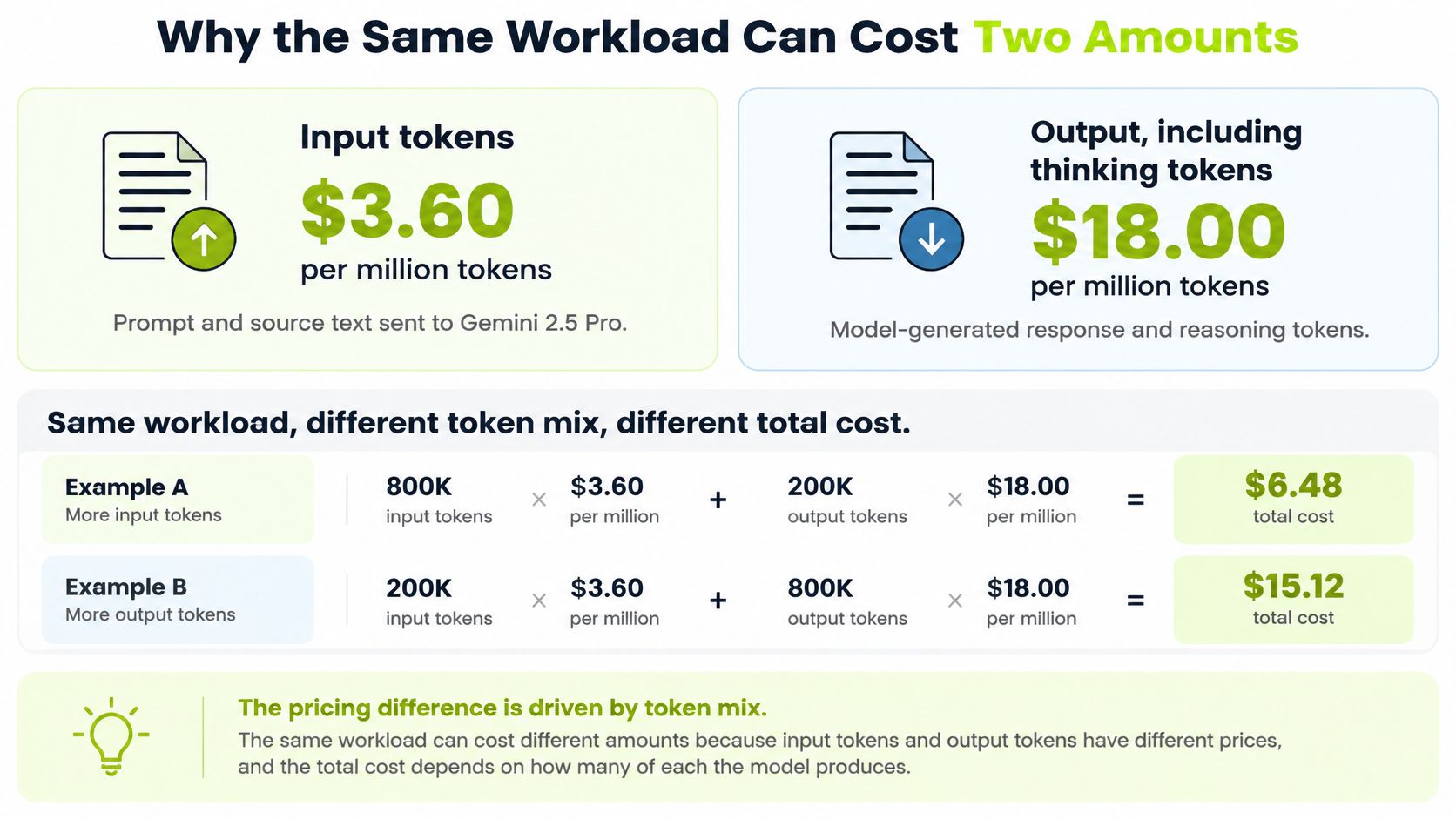
The Google Gemini API pricing page lists Gemini 2.5 Pro at $3.60 per million input tokens and $18.00 per million output tokens, including thinking tokens, for the earlier rate period, then $7.20 input and $36.00 output for the later rate period.
Calculate both sides of the request
The unit is one million tokens, split into input and output. Divide each volume by one million, multiply by the matching rate, then add the two sides.
- Calculate input charges. Under the earlier rates, the assumed input volume produces: 1,000,000 ÷ 1,000,000 × $3.60 = $3.60.
- Calculate output charges, including thinking. The assumed output volume produces: 200,000 ÷ 1,000,000 × $18.00 = $3.60.
- Add the components. The illustrative monthly token bill is $3.60 + $3.60 = $7.20.
- Repeat for the later rates. The same calculation becomes $7.20 for input plus $7.20 for output, totaling $14.40.
Gemini 2.5 Pro monthly cost for 1M input and 200K output tokens
| Rate period | Input cost | Output cost | Total per month |
|---|---|---|---|
| Earlier published rate | $3.60 | $3.60 | $7.20 |
| Later published rate | $7.20 | $7.20 | $14.40 |
The distinction between input and output is visible in the rate comparison.
The token mix changes the effective price
An input-only estimate excludes a separately billed component. When the output rate is higher, even a shorter response can carry real weight in the total, particularly when billable reasoning is included.
That creates a gap between visible answer length and metered output. A buyer should not estimate charges solely from the text shown to the end user if the service also bills thinking tokens.
A plan that looks cheaper on input rate can lose once the response share grows, because output is the expensive side of the unit. In this example, doubling the rates doubles the bill while the workload stays flat.
A purchasing record should preserve the vendor, model, input rate, output rate, applicable rate period and quote date. Before renewal, rerun the same workload against the current schedule rather than carrying forward an old monthly estimate.
Matching a Pricing Model to Your Usage Pattern
Rankozo's AI tools price index reports a $12 monthly median starting price, permanent free plans for 71% of its 17 tools, and Midjourney as the cheapest paid tier at $8 per month. Its published prices were checked on November 4, 2026, with the median based on 15 verified starting prices.
The index covers AI assistants, coding tools, business add-ons and model APIs. Each starting price is the cheapest paid plan, copied word for word from the vendor's US pricing page with the date recorded; those entry prices are market reference points, not equivalent workload quotes.
Choose the structure before the tier
Which pricing model fits which usage pattern
| Situation | Model that usually fits | Why it fits | Main risk |
|---|---|---|---|
| Small team using one assistant daily | Per-seat subscription | Fixed fee per person is easy to budget | Seat count grows with each hire |
| Pilot with uncertain volume | Usage or credit plan with a spend cap | Charges follow consumption | Overage rates after a limit |
| Steady high-volume automation | Capacity commitment | Reserved throughput can lower the effective rate when sufficiently used | Unused committed capacity is still billed |
| Document or ticket processing | Output-based pricing | Charges follow completed items | Unclear definition of a completed output |
| Workflow tied to revenue | Outcome-based pricing | Cost follows the business result | Limited availability, with results requiring contractual definition and attribution |
These are decision rules, not guarantees of savings. A capacity commitment only offers an attractive effective rate if the buyer uses enough of the reserved allowance. An outcome contract only aligns price with value when both parties agree on what counts and which system caused it.
Compare completed work at an acceptable quality level
The useful denominator is accepted work, not merely generated work. A document extraction that requires correction should carry its review cost into the comparison; a workflow that fails before completion shouldn't count as a successful result.
The Stanford HAI 2025 AI Index reports that the cheapest route to GPT-3.5-level MMLU performance fell from $20 per million tokens in November 2022 to $0.07 in October 2024, a reduction of roughly 286 times. That benchmark-specific decline isn't a universal production rate, but it demonstrates why static cheapest-model rankings age quickly.
A higher token rate can still produce a lower cost per accepted task if the workflow needs fewer attempts or less correction.
Buyers should apply the decision table to actual monthly volume before ranking list prices. The same purchasing discipline applies when cutting SaaS costs: remove spending that doesn't support required work rather than choosing a cheaper label that creates more operating expense.
Budgeting Pilot Bills and Choosing a Plan
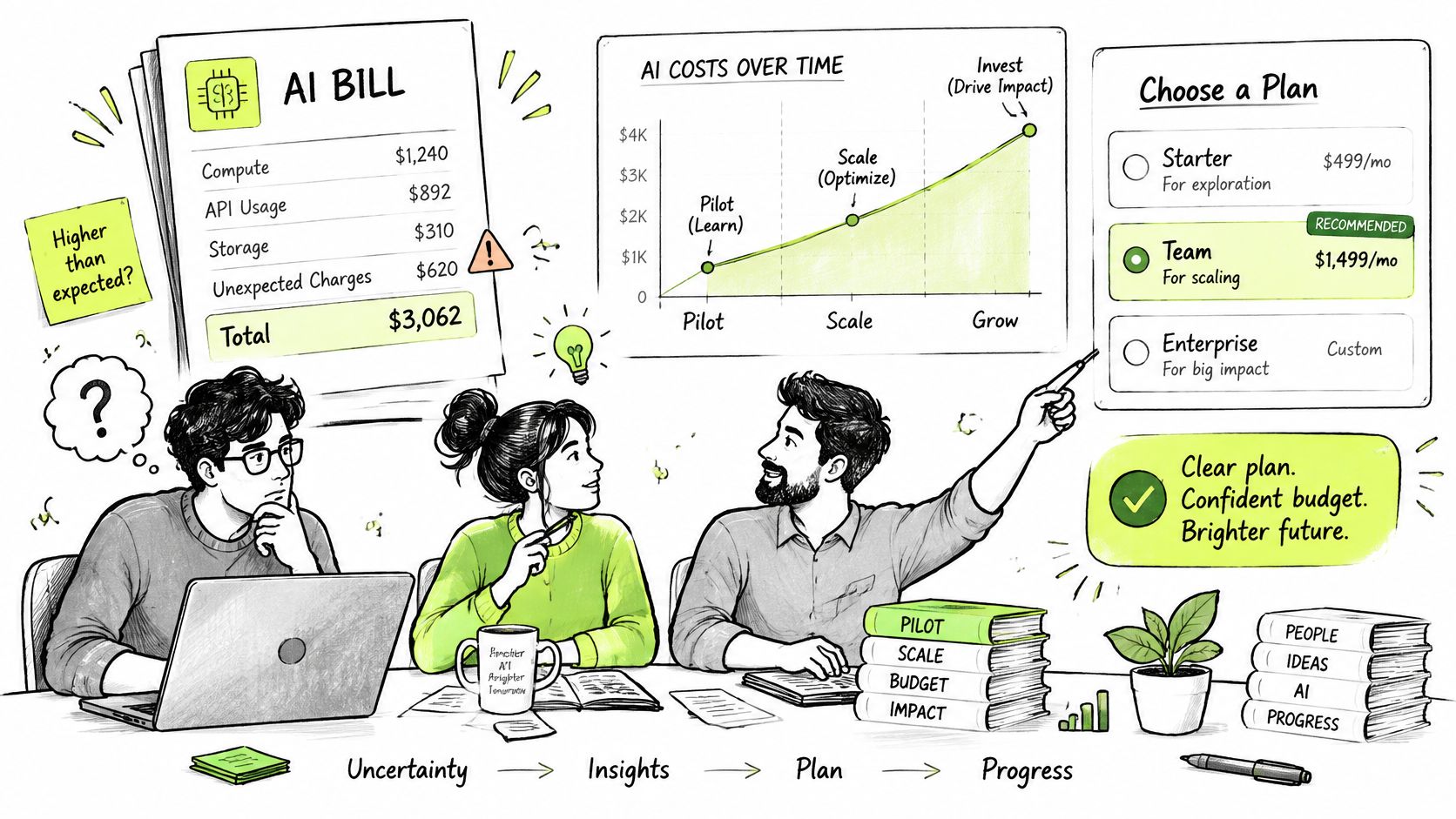
The lowest unit price doesn't establish the lowest production bill. In Capgemini's 2025 survey of organizations exploring generative AI, 57% of organizations piloting GenAI experienced unexpected bill shocks, compared with 46% already scaling it, while GenAI investment increased by an average of 9%.
Those findings make budget variability a purchasing concern in its own right. A low rate can't control spending when an application sends longer context, executes more agent steps or routes more requests to an expensive model.
Budget planning should connect those technical choices to an operating forecast.
Build low, expected and peak estimates
| Budget scenario | Workload assumption | Costs included |
|---|---|---|
| Low | Limited adoption and straightforward requests | Base fees, metered processing and minimum operating overhead |
| Expected | Planned adoption and a representative task mix | Input and output, retrieval, storage, monitoring and routine review |
| Peak | Busy periods, difficult tasks and degraded completion rates | Additional calls, retries, longer context, tool use, extra review and overages |
Each scenario should use the same cost categories so the totals remain comparable. Request volume, the input-to-output ratio and paid retrieval calls belong beside storage, monitoring and human-review time, not in separate budgets that obscure the workflow's total expense.
A practical model is base fees plus metered processing plus supporting services plus human review. Review time should be multiplied by the buyer's applicable labor cost, while retries and tool calls should be measured as additional consumption rather than hidden inside an optimistic average.
Check the commitment, not just the forecast
An annual discount pays off only after the commitment's break-even point. If the team stops using the service earlier, a lower advertised monthly equivalent may still produce a larger total payment.
The contract review should also establish whether renewal changes the rate, allowance or billing unit. Those are separate changes with different effects on the forecast.
- Identify the billing unit: Match the invoice trigger to a measurable operational quantity.
- Choose the relevant usage pattern: Select the structure that fits the workflow rather than the most attractive entry price.
- Calculate each scenario: Include retries, review, supporting services and overages.
- Check dates and renewal terms: Preserve the rate evidence and confirm which terms apply during the commitment.
The deciding question is which structure stays within budget at expected scale, not which model has the cheapest token.
Before a trial or annual commitment, buyers should select one workload, write its monthly volume in the vendor's billing unit and calculate low, expected and peak costs. The AI tools pricing index links published prices to their source pages; Rankozo quotes vendor prices on the date shown, so each applicable rate should be rechecked before that workload becomes a purchase.
Questions or corrections: editorial@rankozo.com