Guide · General
How Much Does Email Marketing Cost? a 2026 Price Guide
How much does email marketing cost? Small lists run $0 to $100 a month on software; managed programs reach thousands. See ranges by contacts and labor.
By the Rankozo research desk · Updated November 9, 2026 · 11 min read
Email software for a small list can cost $0 to about $100 a month, according to Email Platform Review's pricing research, while managed email programs range from $600 to $7,000 a month in SeeResponse's agency pricing review. Both figures are market estimates rather than vendor quotes, and the spread between them reflects what the price covers: a bare platform subscription at one end, campaign production, strategy, automation and deliverability work at the other.
That spread is why the monthly subscription is a weak yardstick. The fairer comparison is the all-in 12-month total divided by inboxed subscribers, because a $0 plan that leaves the sender paying for production and deliverability separately can cost more per delivered message than a $7,000 program that absorbs that work. The subscription is only one line of the bill, and a low plan price can still produce a high cost per inboxed email.
Table of Contents
- Monthly Email Marketing Cost Ranges Compared
- Platform Fees by Contact Count and Send Volume
- Freelance, Agency and Project Rates Compared
- Hidden Costs of Deliverability and Compliance
- How to Build Your Own Email Marketing Budget
- Choose the Cheapest Plan That Still Works
Monthly Email Marketing Cost Ranges Compared
Sixty percent of 250 U.S. marketers spent $51 to $1,000 per month on email marketing, with the most common allocation at 6% to 10% of total marketing spending, according to a survey cited in Email Platform Review's pricing research. The spread exists because "email marketing" describes different purchases. At one end sits a platform subscription for a small list. At the other, a managed program where the software line is the smallest number on the bill.
At the low end, Email Platform Review estimates software for a small contact list at $0 to about $100 per month. That figure buys access to the sending platform, with list size, sending frequency and automation needs pushing the fee within the range. Writing, design, testing and reporting sit outside it.
| Program type | Typical monthly cost | What the price covers | Source |
|---|---|---|---|
| Software only, small contact list | $0 to about $100 | Platform subscription for a small database | Email Platform Review |
| Survey of 250 U.S. marketers | 60% spent $51 to $1,000 | Platform, templates, copy, design, list care and reporting | Survey cited in industry pricing research |
| Light agency support | $600 to $1,500 | Monthly support | SeeResponse pricing review |
| Campaigns with automation | $1,500 to $4,000 | Campaigns combined with automation | SeeResponse pricing review |
| Full program management | $4,000 to $7,000 | Strategy and execution | SeeResponse pricing review |
The next tier, light agency support at $600 to $1,500 per month, buys ongoing help rather than platform access alone. Campaigns combined with automation rise to $1,500 to $4,000 per month in SeeResponse's pricing review, reflecting the added work of building and maintaining customer journeys. Full program management reaches $4,000 to $7,000 per month for strategy and execution.
The ladder shows why a platform quote is an incomplete budget. Database size, campaign frequency, audience segmentation, deliverability work and automated journeys each add labor or push the account into a higher software tier, so the monthly subscription understates what a sender pays.
The honest comparison is the all-in 12-month total divided by inboxed subscribers, not the sticker price. Add the platform fee, recurring production and management, and one-time setup across a full year, then divide by the subscribers who receive the mail. Deliverability and compliance belong in that calculation as their own budget lines, because a cheap plan that lands in spam costs more per inboxed email than a pricier plan that arrives.
Platform Fees by Contact Count and Send Volume
Rankozo's Marketing and SEO price index puts the cheapest paid tier at $9 per month for Brevo, the median starting price at $19 per month across 15 verified prices, and the share of tools with a permanent free plan at 58% of 19 tools. These figures provide entry points rather than a guaranteed quote for a particular list size or sending schedule.
| Measure | Value | Source |
|---|---|---|
| Cheapest paid tier | Brevo at $9 per month | Rankozo Marketing and SEO price index |
| Median starting price | $19 per month across 15 verified prices | Rankozo Marketing and SEO price index |
| Tools with a permanent free plan | 58% of 19 tools | Rankozo Marketing and SEO price index |
| Factors that raise the fee | Subscriber volume, sending frequency and automation | Email Platform Review |
A starting figure in a price index is not a per-contact rate card. A small database may fit inside a free or low-cost plan, while a larger list or more frequent sending can push the account into a higher tier. Automation can raise the price again if the flows a program needs sit in a more advanced plan. Email Platform Review identifies subscriber volume, sending frequency and automation requirements as the factors that move software cost.
The sharper yardstick is the all-in 12-month total divided by the subscribers who receive the mail. Two plans at the same monthly fee can produce very different costs per inboxed subscriber once contact bands and send limits apply. Deliverability and compliance belong inside that total as their own budget lines, because a cheap plan that reaches fewer inboxes costs more per delivered subscriber than its sticker price suggests.
Before comparing prices, match the plan to the actual workload. A low entry price can be misleading if it doesn't cover the list size or send volume the business needs.
Use this three-step check before choosing a platform:
- Match the current contact count to a plan tier. Include expected list growth, because contacts can move the account into a more expensive band.
- Confirm that the needed automation is included. Check whether the plan covers the flows and segmentation the program will use, rather than assuming every tier includes them.
- Confirm the monthly send limit. A plan that fits the contact count can still be unsuitable if its sending allowance is too low.
A free plan is a reasonable fit for a small, low-frequency list that doesn't need advanced automation. A paid plan is the more practical choice when larger sends or automated journeys are part of the program. Rankozo's index records entry prices, so the exact contact band and send allowance still need to be checked against the vendor's published plan before the 12-month math above means anything.
Freelance, Agency and Project Rates Compared
The subscription is often the smallest line on an email marketing bill. Email Platform Review puts beginner freelance email marketers at $15 to $35 per hour and experienced specialists in major markets at $75 to $150 per hour. SeeResponse reports a wider freelance band of $15 to $40 per hour, with a median near $25 per hour, and agency email work at $100 to $149 per hour. An agency hour therefore costs roughly three to six times a median freelance hour, before any difference in scope is considered.
| Service | Rate or fee | Source |
|---|---|---|
| Freelance email marketer, beginner | $15 to $35 per hour | Email Platform Review |
| Freelance email marketer, full range and median | $15 to $40 per hour, median near $25 | SeeResponse |
| Experienced specialist, major markets | $75 to $150 per hour | Email Platform Review |
| Agency email work | $100 to $149 per hour | SeeResponse |
| Campaign setup, templates or list building | $500 to $2,000 per project | Email Platform Review |
| Agency project engagement | $10,000 to $49,999 | Clutch reviews, cited by SeeResponse |
At the project level, campaign setup, template creation or list building typically costs $500 to $2,000, according to Email Platform Review. Larger agency engagements most often fall between $10,000 and $49,999, based on Clutch reviews summarized by SeeResponse. These figures describe different scopes. A defined setup project is not equivalent to an ongoing engagement, so the two ranges should be budgeted as separate line items.
The math shows where the money goes. Twenty hours of production at the $25 freelance median comes to $500, the bottom of the project band. The same twenty hours billed at the $100 agency floor reaches $2,000. The work behind the agency rate explains part of that gap: copywriting, visual design, segmentation, A/B testing, compliance, inbox placement, analytics and lifecycle automation, on top of sending the campaigns.
For a wider labor comparison, Rankozo's freelance rate statistics put these email-specific figures in context, though each quote still needs to be compared line by line. The budgeting rule is to keep recurring platform fees separate from one-time implementation and per-campaign production, then total the full 12-month cost of both. That makes it easier to spot a plan or quote that looks inexpensive only because key work is billed elsewhere.
Hidden Costs of Deliverability and Compliance
A send to 100,000 addresses doesn't mean 100,000 inbox placements. Shopify's email marketing statistics coverage reports 83.5% inbox placement, 6.7% spam placement and 9.8% of messages missing. At that benchmark, about 83,500 messages from a 100,000-address send reach inboxes before opens or clicks.
The useful comparison is cost per inboxed delivery, not just cost per campaign or per month. Divide total spend by the number of messages that reach inboxes. A hypothetical $500 send to 100,000 addresses costs $0.0050 per address. If about 83,500 reach the inbox, the spend works out to about $0.0060 per inboxed delivery. That gap widens fast as list quality drops: at a lower placement rate the same $500 buys fewer inboxed deliveries, so a cheaper plan can still be worse value.
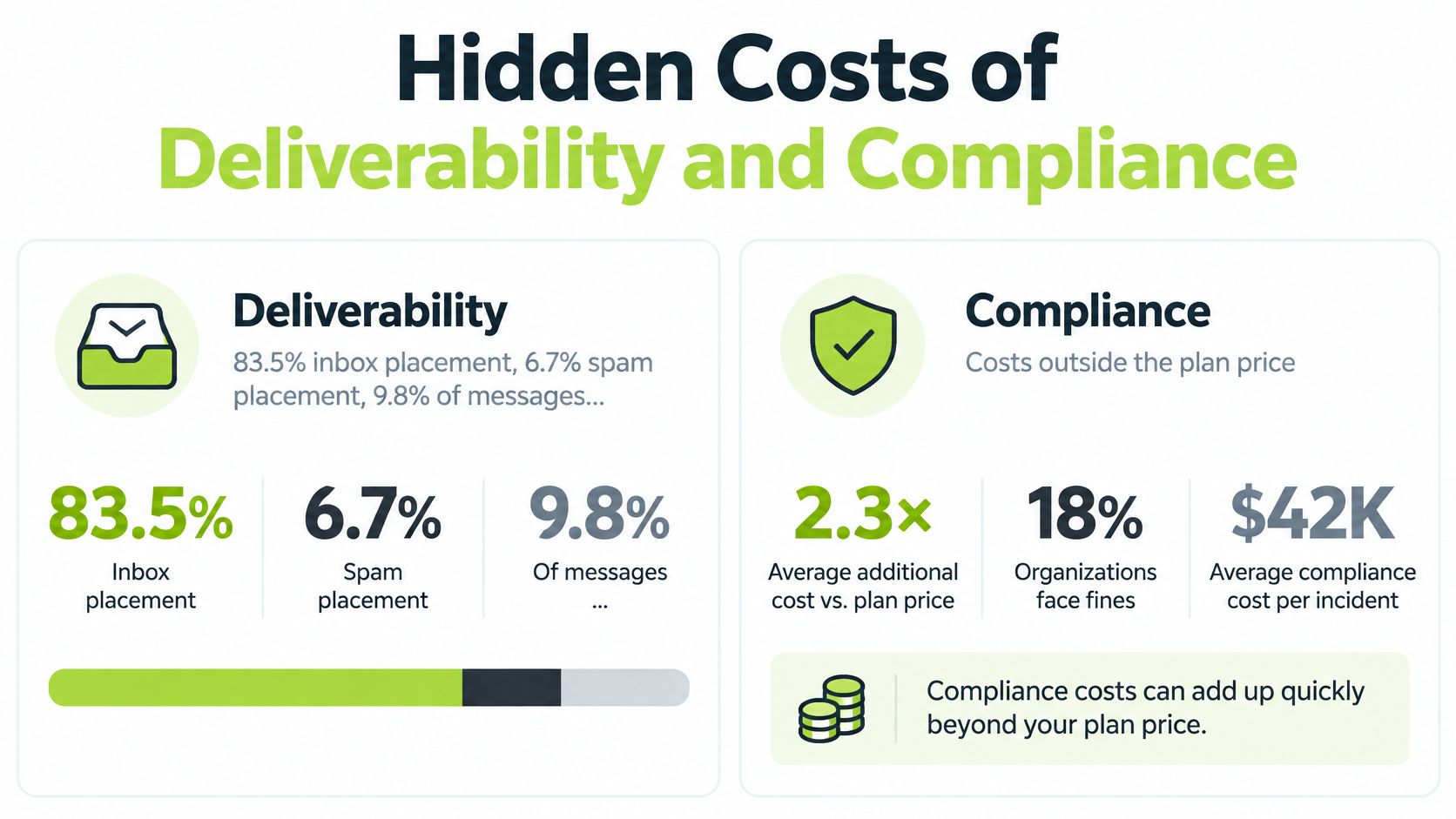
Deliverability work can require SPF, DKIM and DMARC authentication, domain warming, monitoring, list cleaning and specialist audits. Each item is a budget line beyond the subscription, and each protects the sending volume already being purchased. Skipping them lowers the inbox count without lowering the bill.
Compliance creates a different kind of exposure. The FTC's CAN-SPAM Act compliance guide states that each separate violating email may be subject to a civil penalty of up to $53,088. The guide requires accurate header information and subject lines, identification of commercial messages as advertisements, a valid physical postal address and a working opt-out mechanism. Because the penalty applies per email, a single noncompliant campaign sent to a full list multiplies the exposure. The figure is a U.S. enforcement ceiling rather than an ordinary operating cost, but it makes the review line in the budget easier to justify.
Budget list cleaning and authentication before the first send. A plan price won't show whether the audience can be reached or whether the message meets the rules.
How to Build Your Own Email Marketing Budget
A $9 monthly plan can still cost over $6,000 a year to run. That gap is why a working budget starts with the workload rather than the software quote: contact growth, labor, acquisition, deliverability work and compliance each carry costs the subscription leaves out. Vendors also price in different units, so a $10 per user plan and a $10 per account plan are different deals.
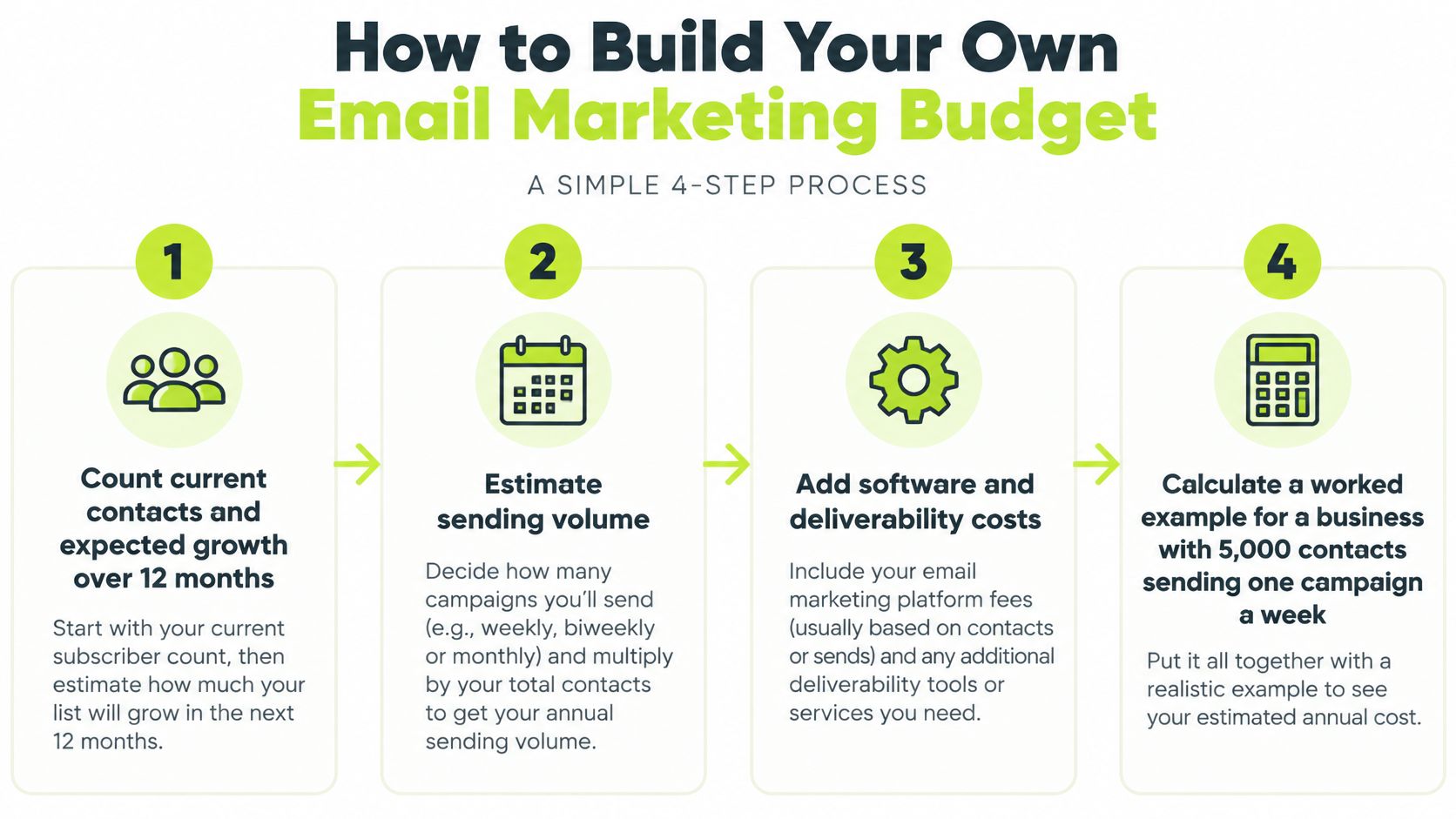
- Count current contacts and expected growth over 12 months. Contact tiers can change the platform fee, so budget against the projected list rather than today's count.
- Confirm the pricing unit. Establish whether the quote is per user, per account or another unit before comparing vendors.
- Estimate production labor. Multiply the expected copywriting and design hours by the applicable freelancer or agency rate, and keep one-time setup separate.
- Add list acquisition and deliverability. Include audience-building, authentication setup, monitoring and list cleaning instead of assuming the platform price covers them.
- Add a compliance review line. CAN-SPAM exposure applies to individual violating emails, so the review should cover the actual messages and sending process.
- Total the year and divide by inboxed deliveries. Projected annual spend divided by expected inbox placements gives an all-in cost per inboxed delivery.
For the worked example, take a business with 5,000 contacts sending one campaign a week. The annual send volume is 5,000 contacts multiplied by 52 weekly campaigns, or 260,000 attempted deliveries. At the 83.5% inbox-placement benchmark Shopify reports, that equates to about 217,100 inboxed deliveries.
Filled with actual figures, that budget looks like this:
| Annual budget line | Example total |
|---|---|
| Platform fees | $108 (Brevo entry tier at $9 per month x 12) |
| Copy and design labor | $5,200 (52 campaigns x 4 hours x $25 per hour freelance median) |
| List acquisition and cleaning | $0 (the 5,000 contacts are already in place; add cost per new contact if buying growth) |
| Authentication and monitoring | $1,000 one-time setup (within the $500 to $2,000 setup range) |
| Compliance review | $50 (2 freelance hours x $25) |
| All-in 12-month total | $6,358 |
Divide $6,358 by the estimated 217,100 inboxed deliveries and the true cost lands at about $0.029 per inboxed delivery. The platform line alone accounts for under 2% of that total, which is why comparing plans on subscription price misleads: labor dominates the bill. If the cost exceeds the value each delivery generates, reduce production hours first, then test whether a lower plan tier still meets the sending and automation needs, and recalculate. Rankozo's marketing budget statistics provide further context for building a budget around actual spending categories.
A return benchmark works as a reasonableness check on that calculation. The 2024 APSIS Email Benchmark Report gives a range of €32 to €45 returned per €1 spent across industries (APSIS report). Those ratios cover more than platform fees: list growth, creative work, strategy, automation and staff time all feed the result. Actual returns depend on audience quality, conversion and attribution, so treat any benchmark as a ceiling to test against rather than a promised outcome.
Choose the Cheapest Plan That Still Works
Cheapest is a 12-month figure, and the subscription is only the floor of it. A free or low-tier plan can still be the right choice for a small list with occasional sends and no need for automation. Rankozo's Marketing and SEO price index shows that 58% of its 19 tools offer a permanent free plan, so a free tier is worth testing first, provided its contact limit, sending allowance and features match the actual program.
A program built on automated flows, behavioral segments or consistent inbox placement needs a paid tier, with authentication and list work priced into the budget alongside it. A low monthly fee that excludes the features or operational work needed to reach the intended audience raises the cost rather than lowering it.
For a team without an in-house writer or designer, production labor is the bigger variable in the comparison. Freelancers suit defined pieces of work or limited hours, while an agency fits a program that needs continuing strategy and execution. Compare both on an all-in 12-month basis, including setup, campaign production and any separately billed design or automation work. Rankozo's email marketing ROI statistics can frame the wider return discussion, though each business still needs its own cost and attributed-revenue calculation before the spend is justified.
Before buying, check the price unit. A price per user isn't equivalent to the same price per account, and the number of users can change the annual total. Rankozo's price-index method records the cheapest paid plan price copied from the vendor's pricing page as shown to U.S. visitors, along with the date checked. Because vendor prices change, confirm the current price and plan limits on the vendor's pricing page before committing to a plan.
The decision rule: select the lowest-cost plan that supports the required list size, send volume and automation, then add labor, deliverability and compliance to the comparison. Compare current plans in Rankozo's Marketing and SEO price index and recalculate the total at the projected 12-month contact count before choosing a vendor.
Small businesses and procurement teams can now compare email platforms on the annual cost of reaching inboxes, rather than the subscription headline alone. Build the 12-month budget with current vendor quotes, include the work needed to keep messages deliverable and compliant, and choose the least expensive plan that can reliably support the program.
Questions or corrections: editorial@rankozo.com