Guide · General
10 Financial Analysis Software Tools Compared on Cost
Compare 10 financial analysis software tools on forecasting, reporting, integrations and total cost, with pricing status checked for each.
By the Rankozo research desk · Updated November 28, 2026 · 17 min read
Spreadsheets remain standard even when finance teams buy planning software. In the Association for Financial Professionals' 2025 FP&A Benchmarking Survey, 96% of respondents used spreadsheets for planning, while 93% used them daily or weekly for reporting. Buying another platform doesn't necessarily remove the existing workflow or its cost.
The cheapest workable option is often the one a business already pays for. For a small business with reliable books and straightforward reporting, adding suitable reporting capabilities to its accounting subscription can be more economical than implementing a separate planning platform. Dedicated suites become relevant when finance needs governed forecasts, consolidation, or coordinated departmental plans.
Rankozo's Finance & accounting price index puts the median starting price at $9.04 per month, with 42% of tools offering a free plan. That broader category isn't a dedicated FP&A pricing benchmark. Vendor-specific checked dates must accompany prices before they're treated as current offers.
These financial analysis software options are ordered around purchasing scope, starting with accounting-led reporting and moving into specialist planning. Quote-only products cannot be ranked reliably by total cost without comparable proposals. Their position isn't evidence that one costs less than another.
The important distinction is what each purchase replaces. QuickBooks Online can hold the books. Fathom analyzes accounting data. Spreadsheet-centered platforms retain familiar models, while broader planning suites coordinate finance and operational assumptions. Costs rise when buyers add entities, contributors, connectors, implementation services, and specialist modules.
Table of Contents
- 1. QuickBooks Online
- 2. Fathom
- 3. Datarails
- 4. Workday Adaptive Planning
- 5. Prophix One
- 6. Anaplan
- 7. Planful
- 8. Vena
- 9. Pigment
- 10. Cube
- How the 10 financial analysis software tools compare on pricing, forecasting, reporting and integrations
- Price the Full Plan Before You Pick a Financial Analysis Software Tool
1. QuickBooks Online
QuickBooks Online pricing varies by plan and region and changes over time. Compare the current plans on the QuickBooks Online pricing page and note the date before approving a purchase. For an existing customer, the starting point is the incremental cost of upgrading an accounting subscription already being paid for, which is often far below the cost of buying a separate reporting platform.
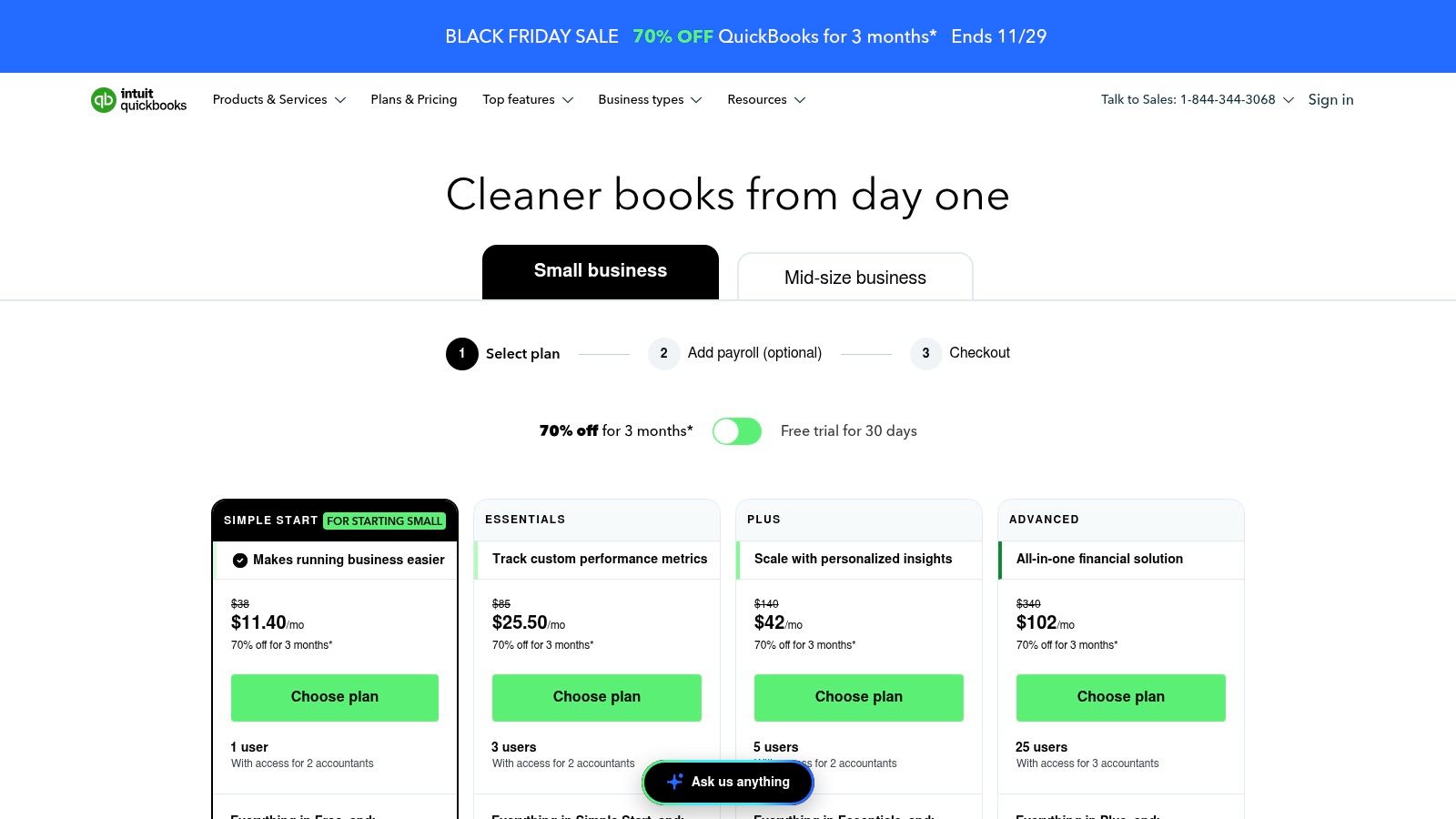
QuickBooks combines bookkeeping with profit-and-loss, balance-sheet, and cash-flow reporting. Budgeting, forecasting, dashboards, KPI tracking, and cash-flow scenarios depend on the selected plan; Advanced adds reporting capabilities and app integrations. Because those capabilities sit behind higher tiers, the plan price a buyer sees first may not cover the reporting they need.
Price the upgrade, not another system
For an existing customer, the relevant comparison is an accounting-plan upgrade against a separate reporting subscription plus its setup. A business that needs expense visibility and management statements may not need a dedicated FP&A implementation.
- Confirm the reporting tier: The proposal should identify the required budgets, dashboards, forecasts, and report customization, then match them to the plan that includes each one.
- Separate free access from a paid subscription: A trial or other free offer shouldn't be treated as permanent access to the required business features.
- Test the limits: Complex modeling and multi-entity consolidation may require a specialist product.
The advantage is that bookkeeping and reporting use the same underlying records. The limitation is that buying a higher accounting tier doesn't automatically create a full planning suite.
For businesses choosing their ledger as well as their reporting tools, Rankozo's ranked list of accounting software addresses that broader purchase.
2. Fathom
Fathom publishes company-based prices, so a buyer can estimate cost before talking to sales. CFOpresso's 2026 pricing comparison, citing Fathom's pricing page checked November 5, 2026, lists Pro at $59 per month for one company, $450 per month including 25 companies, and $17 per month for each additional company; it separately lists Portfolio at $67 per month for 100 companies.
Those prices describe different packages, not interchangeable access to the same capabilities. A portfolio-monitoring allowance shouldn't be assumed to include full forecasting and reporting for every connected company.
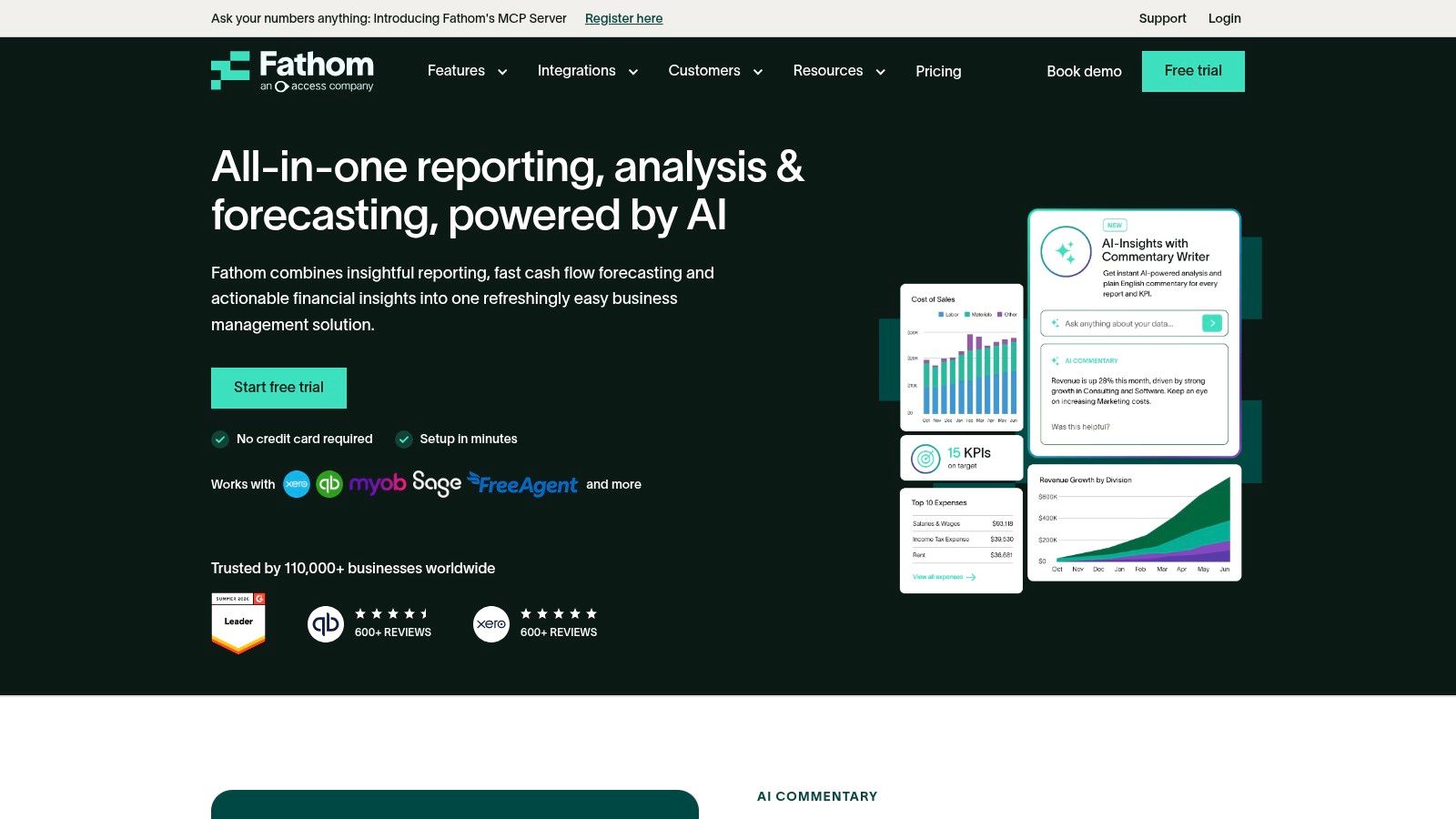
Fathom connects accounting data to management reports, KPI dashboards, budgets, scenarios, and three-way cash-flow forecasting. Its scope also includes multi-currency consolidation, eliminations, and portfolio-monitoring options.
Buying distinction: A connected-company allowance is only useful when the package includes the work that company requires.
The pricing variable here is company count, not user seats. A single-entity business sits near the entry price, while an accounting firm consolidating dozens of client files should model cost from the multi-company figures above. The gap between the two structures is wide enough that miscounting entities changes the budget more than any feature decision.
Best cost position: Businesses and accounting firms that can define their connected-company requirements clearly. Main limitation: Fathom adds analysis to accounting software rather than replacing the ledger or ERP.
Before signing, the buyer should list which companies require forecasting, consolidation, and full management reports, then match that count against the published per-company pricing. A company included only in portfolio monitoring costs far less than one needing the full reporting package, so splitting entities by required depth is where the savings sit.
3. Datarails
Datarails uses quote-based pricing, so buyers need a written proposal that separates the platform, connected systems, implementation, and ongoing support. A headline subscription without that scope isn't a usable comparison. The cost position depends on how much spreadsheet work the product replaces and how much data plumbing finance still needs to fund.
Datarails retains Excel-centered workflows while connecting financial and operational data for consolidation, budgeting, forecasting, reporting, and scenario analysis. Its product scope includes dashboards, linked underlying data, and AI-assisted analysis. That makes it most relevant when existing models carry real value and the main cost problem is repeated data collection, version control, and reporting effort.
Spreadsheet continuity has a setup cost
Keeping Excel can avoid a complete modeling-interface change. It doesn't remove the work of mapping accounts, validating imported data, assigning permissions, or correcting inconsistent workbook logic. The proposal should make those tasks visible because they can sit inside implementation, support, or internal finance time.
- Integration scope: The written proposal should name the ERP, accounting, CRM, and HR connections required.
- Model migration: Finance should establish which existing workbooks can remain intact and which need restructuring.
- Recurring operation: A demonstration should reproduce a close, forecast update, and management report using representative business data.
A useful comparison separates planning from visualization. Rankozo's business intelligence tools comparison can help buyers distinguish a dashboard requirement from a budgeting and forecasting purchase. The same distinction matters here: a quote should show whether the buyer is paying for a planning system, a reporting layer, or both.
Best cost position: Teams with valuable spreadsheet models that need governed data connections and recurring reporting. Main limitation: Teams seeking a spreadsheet-independent planning environment still carry the cost of workbook discipline. Before signing, finance should confirm what is included in each tier, which systems connect, and what support covers after implementation.
4. Workday Adaptive Planning
Workday Adaptive Planning requires custom pricing. No dated, verified subscription amount is available for this comparison, and an existing Workday relationship shouldn't be treated as proof that planning access or implementation is included.
The product, now branded Adaptive from Workday, covers driver-based financial planning, forecasting, reporting, and scenario modeling across finance and other functions. Workday's platform overview describes a broader planning environment than a standalone financial dashboard.
Departmental breadth changes the proposal
The buying case strengthens when workforce and operational assumptions need to feed financial statements. A hiring plan, for example, needs to affect payroll expense and cash forecasts consistently rather than sit in a separate departmental workbook.
The proposal should distinguish finance modeling from workforce planning, operational planning, integrations, and implementation services. It should also identify the access required by model builders, budget contributors, approvers, and report viewers.
The advantage is coordinated planning across departments. The trade-off is the expertise and implementation work needed to maintain those connected assumptions.
A small business requiring basic cash visibility may be buying more system than it needs. A larger organization should instead test whether department owners can submit assumptions, understand their financial consequences, and complete approvals without finance rebuilding their inputs.
Before signing, procurement should obtain an implementation scope tied to the actual models and reporting outputs, not just the software's available capabilities.
5. Prophix One
Prophix One has no published price in the information available for this comparison. Its quote should distinguish planning from consolidation and close-related capabilities, because a broad platform description doesn't establish what a particular contract includes.
Prophix One combines budgeting, driver-based forecasting, scenario modeling, financial reporting, analysis, and consolidation. It is relevant to mid-market finance teams seeking a governed process across planning and close-related work.
Price the required workflow
A company needing only a rolling forecast should compare the planning scope against lighter alternatives. A multi-entity organization may have a different case if it also needs consolidated reporting and coordinated financial processes.
- Planning deliverables: Name the budgets, forecast drivers, scenarios, and approval workflows required at launch.
- Consolidation deliverables: Specify entities, currencies, eliminations, and the management reporting structure.
- Implementation ownership: Identify who maps accounts, validates historical balances, builds reports, and signs off the results.
The potential advantage is reducing separate finance workflows. That advantage only supports a higher price when the business will use the contracted capabilities.
The limitation is configuration effort. A shared platform still needs an agreed chart-of-accounts mapping, reliable source data, and clear process ownership.
Procurement should request an acceptance demonstration using the organization's reporting structure. A polished dashboard isn't enough if finance can't reconcile consolidated totals or explain a forecast variance. The final quote should state what is included, what requires additional services, and what remains outside the initial rollout.
6. Anaplan
Anaplan is quote-based, and no verified vendor-specific starting price is available here. Procurement should budget for model design and administration alongside the subscription, rather than treating enterprise planning as a simple reporting add-on.
Anaplan's finance planning offering links financial plans with operational inputs across departments and business units. Its scope includes financial forecasting, connected models, and scenario analysis.
The reason to consider Anaplan is organizational complexity, not merely a preference for more features. Financial results may depend on sales capacity, staffing, production, and other operational assumptions that need coordinated ownership.
A connected planning model needs a named owner for every major assumption and a controlled process for changing it.
Include the operating model
The written proposal should identify the applications and models included, participating business functions, integrations, implementation partner responsibilities, and ongoing administration. Buyers should also establish how changes to model scope affect commercial terms.
Best fit: Enterprises that need cross-functional planning and can support dedicated model-building skills. Poor fit: Small businesses seeking straightforward financial statements or a basic forecast.
Anaplan shouldn't be mistaken for a replacement accounting system. Organizations reconsidering transaction processing and core business records have a different procurement decision, addressed in Rankozo's ERP software comparison.
The acceptance test should show how an operational assumption changes the financial plan, who approves that change, and how finance traces the resulting variance.
7. Planful
Connected finance work, one unpublished bill. Planful does not list a starting price publicly, so buyers should request a written quote for a defined package rather than assume every advertised capability is included.
Planful places financial planning and analysis beside workforce planning, reporting, financial close, and consolidation. Vendor-described AI insights and collaboration sit inside that same workflow. They do not carry a separate published rate.
The cost question is scope, not a missing sticker price. A team that needs a forecast can still be sold a suite that also covers workforce, close, and consolidation. Decide first whether Planful is meant to replace a spreadsheet forecast, sit next to the accounting system, or take over a full planning and close process. Only the last of those usually supports the wider package.
Separate immediate needs from later modules
Budgeting and reporting can launch now. Workforce planning or consolidation can wait. Price a launch package and a scoped expansion. Do not pay for a rollout whose modules and services are still unnamed.
- Included capabilities: Mark budgeting, forecasting, workforce planning, reporting, and consolidation as in the first invoice, quote-only, or out of scope.
- Delivery responsibilities: Split software access from migration, configuration, training, and support, and state the fee for each, including a stated zero.
- AI controls: Require traceable source data, reproducible calculations, and human approval before a material output changes the plan.
The spend is easiest to defend when several connected finance processes replace separate workbooks. A planning-only buyer should test whether the extra modules cut that work or only add implementation.
Training is its own line. Departmental contributors need a way to submit assumptions correctly. Finance administrators need to maintain structures and permissions. If the quote calls either “included,” confirm the hours before signing.
Have Planful reproduce a budget submission, a forecast revision, and a consolidated management report on the proposed configuration. The quote should say which of those three ship at launch and which need another module or a services engagement.
8. Vena
Vena uses quote-based pricing. No verified subscription amount or checked-price date is available for this comparison, so Microsoft familiarity shouldn't be translated into an assumed low implementation bill.
Vena's financial planning and analysis offering retains Excel-centered workflows while adding budgeting, forecasting, approvals, version control, Microsoft integrations, and AI-supported analysis. Its appeal is governed spreadsheet planning rather than eliminating spreadsheets.
That distinction matters when teams compare migration work. Existing Excel skills may remain useful, but administrators still need to configure models, workflows, permissions, and reporting structures.
Practical rule: A familiar spreadsheet interface doesn't prove that the existing workbook is ready for governed planning.
Confirm the Microsoft dependencies
The proposal should identify the Microsoft products and environments required, the integrations included, and any separate licensing dependencies. Finance should also establish which existing templates can be retained without compromising approvals or version control.
The advantage is continuity for Microsoft-oriented teams. The limitation is that Excel familiarity can conceal unresolved process design, including inconsistent formulas and unclear responsibility for assumptions.
A useful evaluation follows a departmental budget from submission through approval and reporting. Finance should be able to identify the approved version, trace a changed assumption, and prevent unauthorized edits.
The purchase is easier to justify when those controls replace manual workbook circulation and reconciliation. It is harder to justify when the business needs only occasional statements from its accounting package.
9. Pigment
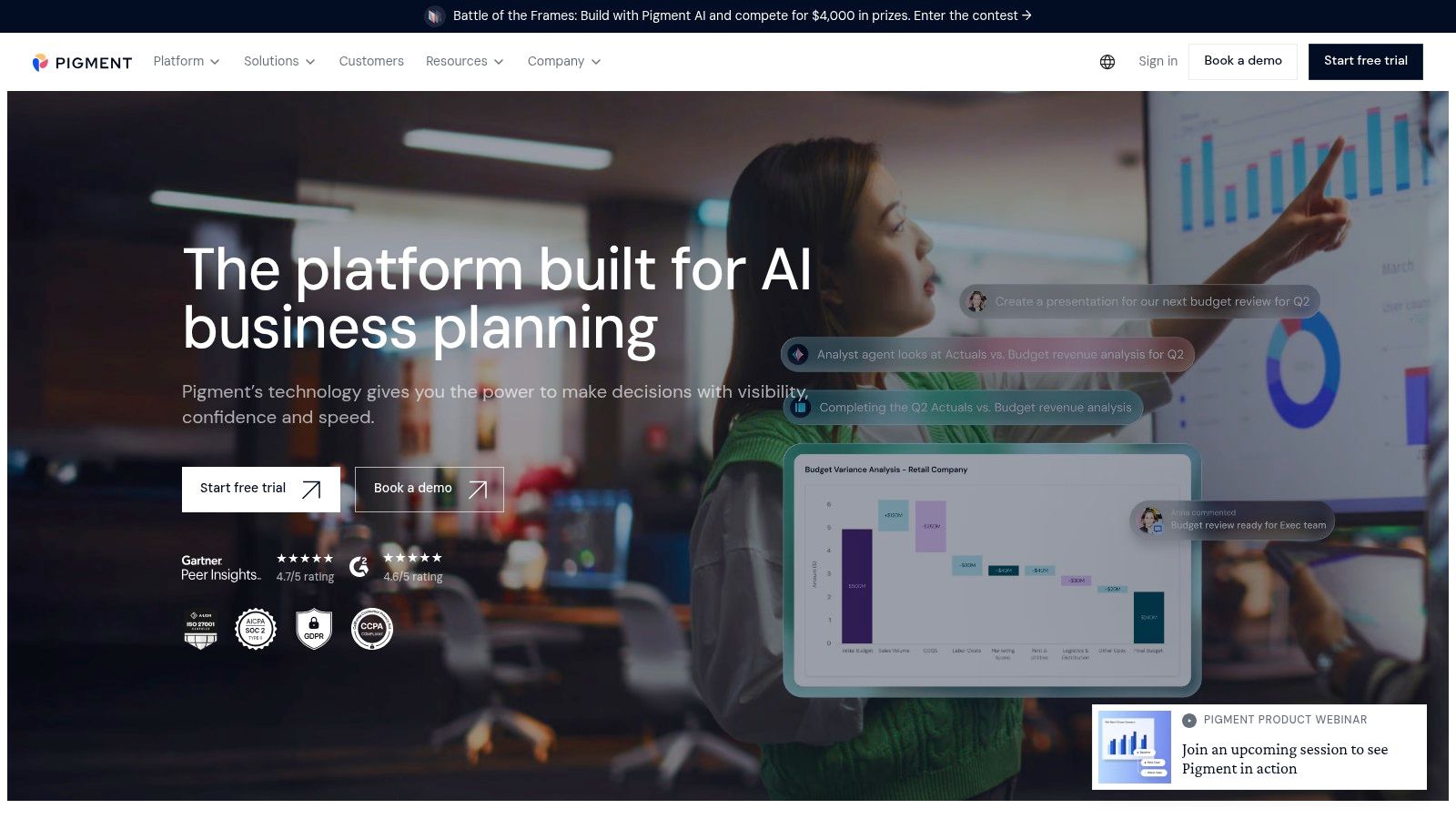
Pigment requires a custom quote, with no verified starting price or checked-price date available here. Buyers should define participating functions and required data connections before comparing its proposal with finance-only software.
Pigment supports financial and operational planning through configurable models, collaborative workflows, scenario analysis, and dashboards. Data connections include native connectors, APIs, and scheduled imports.
Flexibility needs a defined boundary
A business may want sales assumptions, hiring plans, and financial forecasts in a shared environment. The purchasing question is which of those processes belongs in the initial contract and who will maintain the resulting models.
- Connectivity: Name the source applications, refresh requirements, and responsibility for failed imports.
- Participation: Distinguish model builders, contributors, approvers, and viewers in the proposal.
- Governance: Test permissions, model changes, reporting needs, and audit requirements against actual workflows.
The advantage is shared financial and operational planning. The limitation is the design effort needed to keep flexible models understandable and controlled.
Procurement should avoid treating an available connector as a completed integration. Account mapping, data validation, authentication, and error handling still need explicit ownership.
Pigment is a candidate when operational assumptions materially affect the financial plan and several functions need to collaborate. For a business that mainly needs accounting reports, that broader scope can introduce work without solving a larger problem.
Before signing, buyers should require a representative scenario that changes an operational driver and produces an explainable financial result.
10. Cube
Cube publishes tier names and withholds the prices. Bronze, Silver, and Gold are scope outlines. Actual cost arrives only in a written quote, so none of those labels is a budget.
Cube keeps Excel or Google Sheets at the center of planning, reporting, dashboards, and collaboration. The published tiers describe dimensions and roles. Multi-entity options and extra integrations sit on higher tiers. User count is the weak cost driver. Entity structure and source systems are what push the contract up.
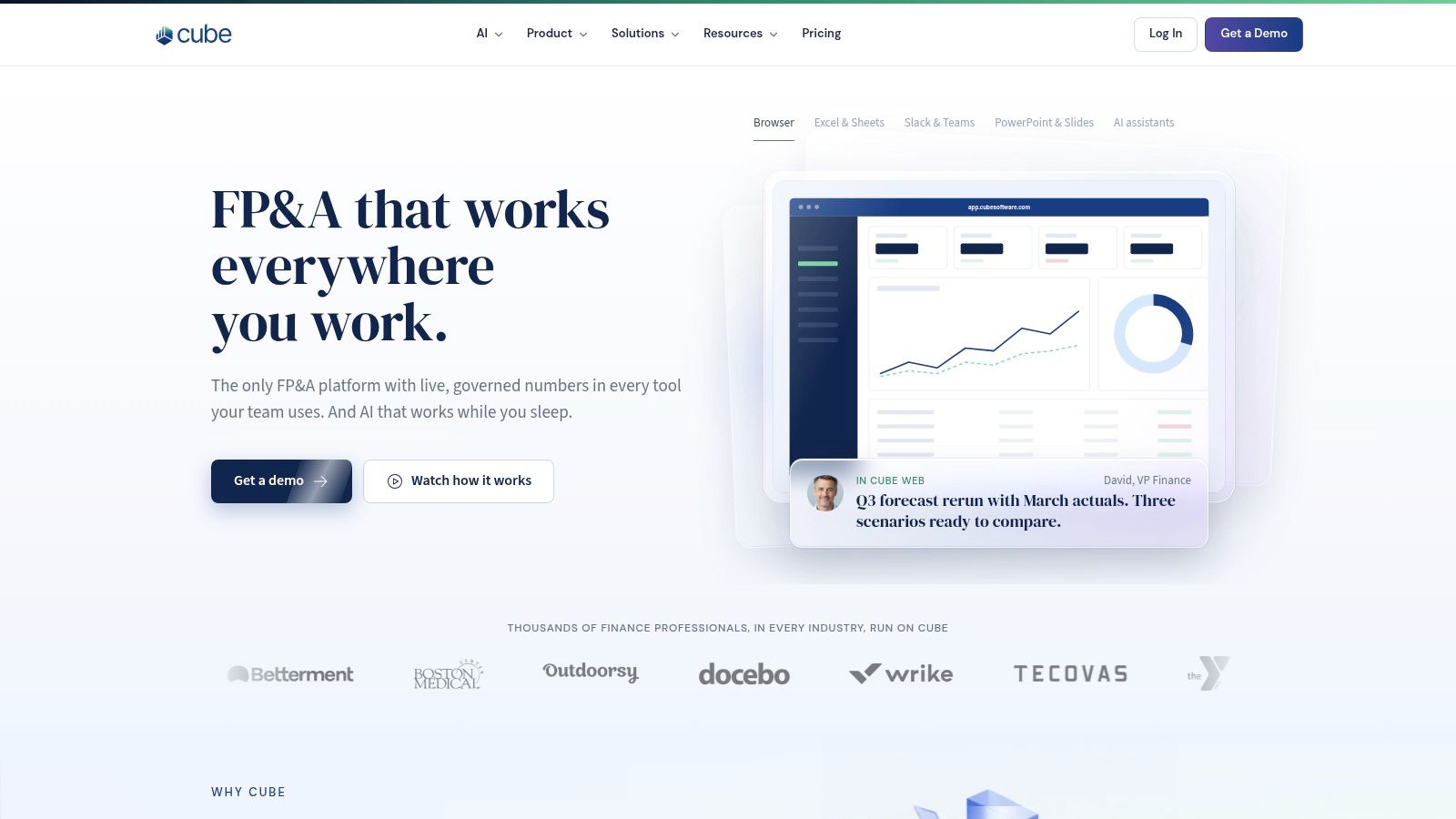
The vendor lists unlimited users and dimensions on Bronze. Treat that as a scope claim, not a priced allowance. The proposal has to say what those words cover, and whether the required companies, connections, and workflows are inside the package being quoted.
Price the tier boundary
A team with few users can still leave Bronze. One extra company, or one source system outside the included connections, changes the tier and the total.
- Entity coverage: Establish whether every required company is in the proposed package.
- Integration coverage: Name the included accounting connections and any systems that appear only on a higher tier.
- Workflow coverage: Match permissions, collaboration, reporting, and support in the quote to the close the team runs.
The published offer is a managed planning layer on familiar spreadsheets. That replaces a loose workbook process. It does not replace a standalone modeling environment, and teams that want one should price that mismatch before they compare feature lists.
Cube sits with Datarails and Vena when keeping workbook workflows is the requirement. Separate them by the written total for entities, integrations, controls, and implementation, not by spreadsheet compatibility.
How the 10 financial analysis software tools compare on pricing, forecasting, reporting and integrations
Total cost sorts these ten tools more cleanly than a feature tally. A published company-based price and a quote-only suite are different buying problems. Each row states what is published, what stays quote-only, and what the buyer must confirm before signing: entities, users, scenarios, reports, and connections.
| Item | Published pricing | Best for | Forecasting and scenarios | Reporting | Integrations and connections |
|---|---|---|---|---|---|
| QuickBooks Online | No verified published price. A trial or free offer is not permanent access; confirm paid plan levels and included features with the vendor | Small businesses seeking bookkeeping and financial visibility | Budgeting, forecasting, cash-flow planning, and what-if scenarios on applicable plans | Bookkeeping reports and financial visibility; confirm which reports sit on the paid plan | Accounting data and app integrations; availability varies by plan |
| Fathom | Published pricing based on connected companies | Accounting firms and businesses monitoring performance across entities | Budgets, scenarios, and three-way cash-flow forecasting | Performance reports across entities, including multi-currency consolidation | Connects accounting data; supports multi-currency consolidation |
| Datarails | Quote-based pricing | Finance teams retaining Excel workflows while automating reporting | Budgeting, forecasting, and scenario comparisons | Automated management reports built from the Excel workflow | Connects ERP, accounting, CRM, and HR systems |
| Workday Adaptive Planning | Custom pricing | Mid-market and enterprise teams coordinating finance, workforce, and operational plans | Driver-based planning and multi-scenario modeling | Finance, workforce, and operational plan reports | Data integrations; particularly relevant to Workday environments |
| Prophix One | Quote-based pricing | Mid-market finance teams needing planning, reporting, and consolidation | Budgeting, driver-based forecasting, and scenario modeling | Planning reports plus consolidation outputs; confirm which packs are in the quote | Central store for planning and financial data. Confirm ERP, accounting, and consolidation connections in the quote |
| Anaplan | Quote-based pricing | Enterprises connecting financial plans with operational inputs | Financial forecasting and cross-functional what-if analysis | Cross-functional plan reports tied to operational inputs | Connects finance and operations across departments |
| Planful | Public pricing not available | Mid-market and larger teams coordinating planning, reporting, and close | Budgeting, forecasting, and workforce and operational planning | Planning, management reporting, and close outputs; confirm the report set in the quote | Planning, reporting, and close workflows. Confirm source systems and close connections before signing |
| Vena | Quote-based pricing | Microsoft-oriented finance teams seeking governed spreadsheet planning | Budgeting and forecasting workflows | Governed spreadsheet reports inside the Microsoft stack | Integrates with Microsoft tools |
| Pigment | Quote-based pricing | Teams coordinating financial and operational plans | Financial forecasting and scenario modeling | Configurable dashboards for financial and operational plans | Native connectors, APIs, and scheduled imports |
| Cube | Quote required; tier descriptions are published | Small and mid-market teams using Excel or Google Sheets | Spreadsheet planning on Excel or Google Sheets. Confirm whether scenario models are in the quoted tier | Planning reports on the spreadsheet layer; report scope follows the quoted tier | Native Excel and Google Sheets connectivity; additional integrations vary by tier |
Quote-only rows (Datarails, Workday Adaptive Planning, Prophix One, Anaplan, Planful, Vena, Pigment, Cube) cannot be ranked by a sticker price. Fathom is the clear published case: cost moves with connected companies. QuickBooks Online has no verified price in this comparison, so a free trial must not be modeled as ongoing access.
Price the Full Plan Before You Pick a Financial Analysis Software Tool
The cheapest subscription isn't necessarily the cheapest deployment. CFO Shortlist's 2026 pricing benchmark places enterprise platforms at approximately $150,000 to $300,000 annually for software alone, with first-year totals reaching $500,000 to $2.5 million or more after implementation. Those are category benchmarks, not quotes for the individual products above.
The buyer's budget should cover the initial subscription period, implementation, integrations, data preparation, training, and the cost of retaining existing workflows during rollout. A platform that replaces recurring manual work can justify a higher subscription, but only when the business defines that work and verifies that the replacement functions.
Put the scope beside the price
Procurement should normalize proposals around the same entities, user roles, connected systems, reporting outputs, and planning workflows. Charges should be multiplied only where the vendor prices by that unit; a company-based allowance and an unlimited-user package shouldn't be modeled as identical licensing structures.
- Subscription scope: Record included modules, entities, users, integrations, support, billing terms, and renewal conditions.
- Delivery scope: Separate migration, configuration, connector work, training, and report construction.
- Internal labor: Assign responsibility for account mapping, historical validation, reconciliation, and administration.
- Acceptance conditions: Specify the forecast, consolidated report, and approval workflow that must function before rollout is considered complete.
Data preparation belongs in the budget before vendor selection. Finance should identify inconsistent account structures, missing operational inputs, and unreconciled historical balances before committing to a migration deadline.
AI-assisted analysis also needs an acceptance standard. Buyers should require underlying sources, reproducible calculations, clear reporting periods, and human approval for material conclusions rather than paying for an assistant whose outputs cannot be checked.
For a small business, the right answer may remain an accounting platform with suitable reporting. For an accounting firm, connected-company economics may matter more than seats. For an enterprise, consolidation, cross-functional planning, and implementation ownership may determine the workable package.
Quote-only products should remain unpriced until a written proposal exists. Procurement should record the date received, the included scope, exclusions, implementation assumptions, and renewal terms, then re-check the commercial position before renewal.
The next step is a scoped price comparison, not another feature demonstration. The buyer should shortlist the accounting-led, reporting-led, or planning-led options that match the actual workflow, obtain dated written prices, and approve the least expensive package that can reproduce the required forecast and management reports with reconciled business data.
Questions or corrections: editorial@rankozo.com