Guide · General
Consignment Store Software: 10 Options Compared for 2026
Compare consignment store software by starting price, consignor payouts, inventory and POS fit. Listed costs, add-on fees and who each system suits.
By the Rankozo research desk · Updated November 16, 2026 · 16 min read
The cheapest subscription can exclude the workflow that makes it usable for a consignment shop. Consignloop, checked in 2026, lists a $29 monthly starting plan and a 21-day trial. Rose's entry tier, by contrast, doesn't include consignment management or payout tracking. Comparing advertised starting prices without checking those boundaries can put unlike products on the same shortlist.
The relevant cost is the subscription that covers consignor ownership, sales splits, returns and payouts, plus any required checkout or ecommerce services. A shop can also incur per-location charges, payment-processing fees, payout charges and migration work. A consignor portal may require an upgrade even when the base plan already calculates balances.
Rankozo only shows a price it can quote from the vendor. Pricing checked in 2026 is identified below. Where a current vendor quote or check date isn't established, the price is marked unconfirmed, rather than presented as a verified offer. Promotional prices also need separate treatment from regular subscription charges.
What belongs in the monthly bill
- Required plan: The lowest tier that handles the shop's consignors and payouts.
- Connected services: Square, Shopify, payment processing and any separate ecommerce subscription.
- Operating charges: Location fees, payout fees, hardware, migration and paid upgrades.
The options below suit different operating models. Their numbering isn't a cheapest-to-most-expensive ranking. A Square-based shop, a Windows-based store and a multi-location resale business shouldn't assume that the same starting plan will work for all of them.
Table of Contents
- What belongs in the monthly bill
- 1. SimpleConsign
- 2. ConsignCloud
- 3. Ricochet POS
- 4. Circle-Hand
- 5. ConsignR
- 6. Rose by Consignor Connect
- 7. Aravenda
- 8. ConsignmentTill
- 9. Liberty Cloud
- 10. Consignloop
- Vendor-listed starting prices, consignor portals and trials across 10 consignment systems
- Choosing the Cheapest System That Still Pays Consignors Right
1. SimpleConsign
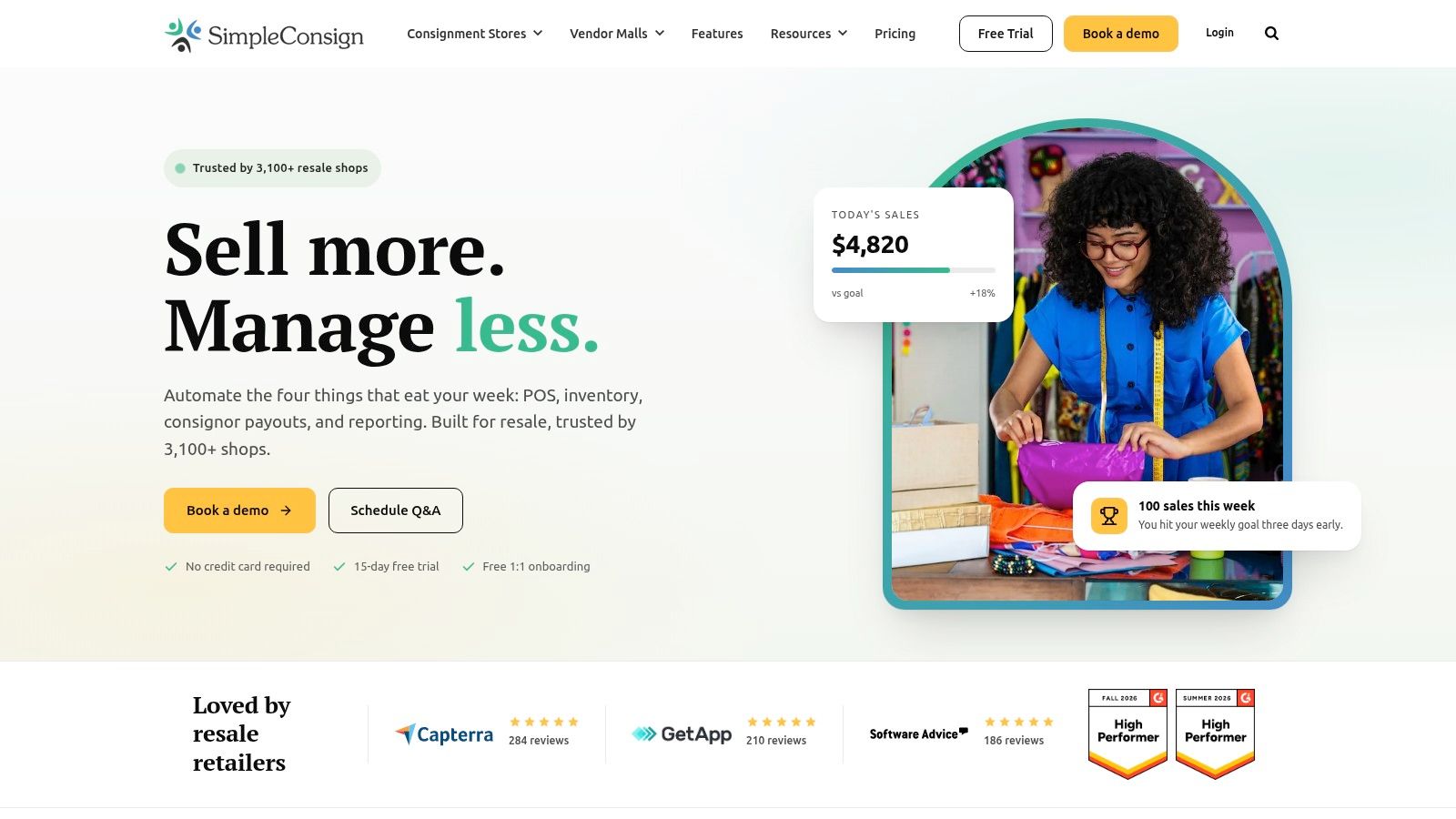
SimpleConsign suits shops seeking a dedicated consignment system rather than a retail register with a separate ownership spreadsheet. Its vendor website describes a cloud platform covering POS, inventory, consignor accounts, reporting, item tagging and payouts, alongside a separate vendor and antique-mall configuration.
Current pricing and the price-check date are unconfirmed. A purchase decision should therefore distinguish the regular subscription from any conditional Professional introductory offer. A temporary discount doesn't establish the ongoing cost.
Shopify and QuickBooks integrations sit within Professional. That makes the integration requirement more important than the lowest advertised tier: a shop that needs those connections should budget around the eligible plan, not an entry subscription.
Where the cost can rise
- Professional features: Shopify and QuickBooks can determine the required tier.
- Mall operations: Booth and rent management call for the Vendor Mall Plus configuration.
- Migration scope: Advertised free migration should be evaluated against the records the shop needs transferred.
SimpleConsign's advantage is its consignment-specific scope. Its drawback is the possibility of paying for a broader plan to obtain a particular integration.
The operational test should include a returned item after a consignor payout has been prepared. Staff should be able to identify the affected balance without rebuilding it outside the system. Rankozo's inventory management software comparison provides useful context for distinguishing stock control from the additional ownership and settlement records a consignment shop needs.
2. ConsignCloud
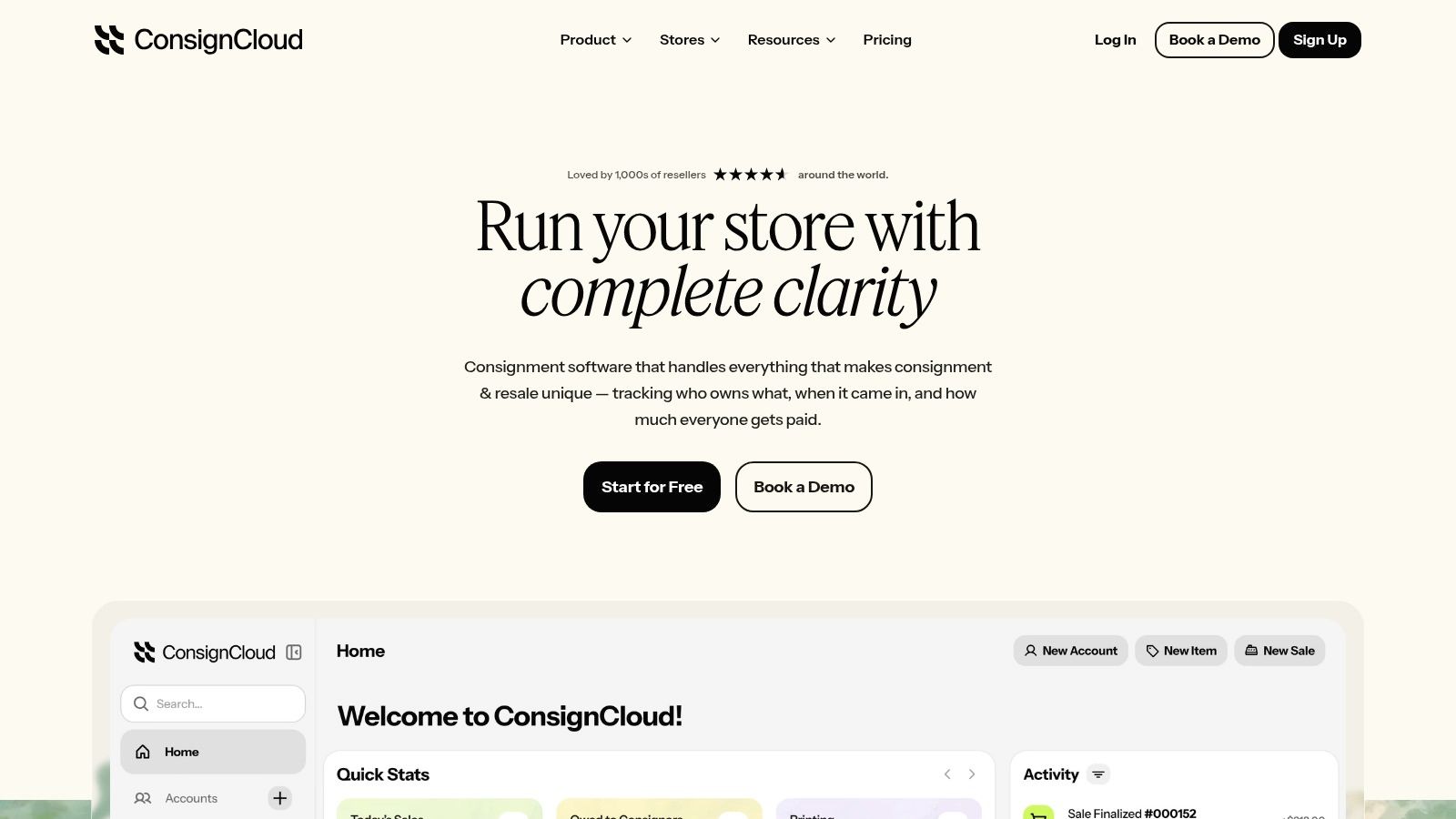
ConsignCloud's pricing, checked in 2026, lists Basic at $139 per month, a higher plan at $189 per month per location, and ACH payouts at $2.50 per payout. Those charges represent different cost drivers: access to the software, access across locations and the act of paying consignors.
Basic covers inventory and consignor management for a store. Pro adds consignor-facing capabilities, including vendor access and a consignor portal, alongside expanded reporting and automated emails.
The distinction matters when owners expect consignors to check their own balances. Self-service may reduce staff enquiries, but the eligible subscription and payout charges still belong in the budget.
Processing can exceed the subscription
In ConsignCloud's comparison, checked in 2026, its Stripe integration costs 2.7% plus $0.05 per transaction; the vendor's example of $10,000 in monthly card sales, averaging $20 across 500 transactions, produces $295 in processing charges and $434 including Basic.
That example isn't a universal operating budget. It excludes other expenses, including applicable payout charges.
Cost rule: Software, customer payment processing and consignor payouts are separate charges. A usable comparison must include all applicable categories.
ConsignCloud is worth considering when a shop wants dedicated consignment records with room for a portal and location growth. The decision turns on the required tier and payout pattern, not Basic alone. Payout reporting should also show failed transfers and adjustments clearly enough for staff to reconcile the amount owed.
3. Ricochet POS
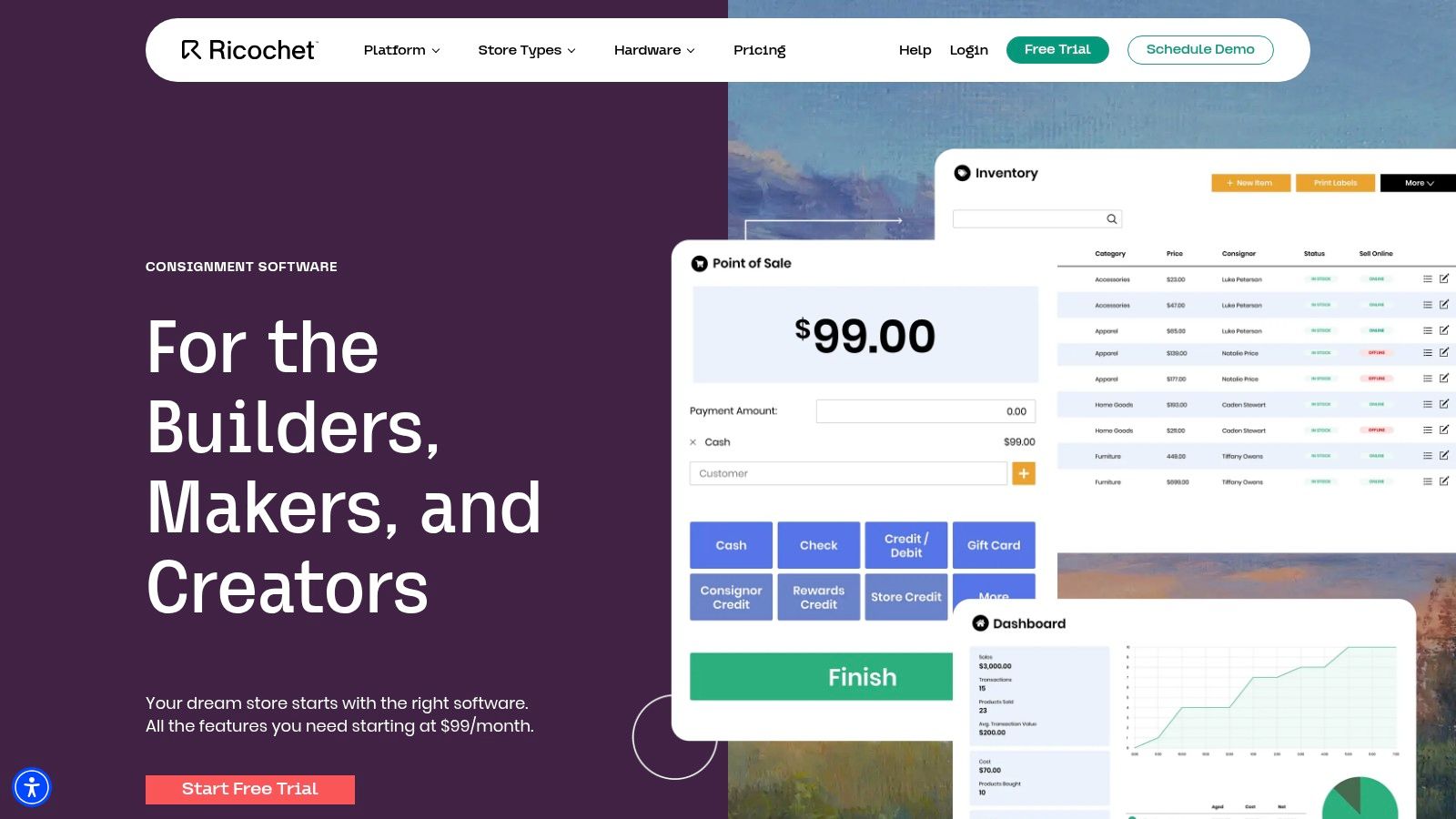
Ricochet's ecommerce product needs its own place in the budget. Ricochet POS combines consignment inventory, consignor accounts, checkout and payout reporting. Ricochet Go provides consignor-facing access, while Ricochet Web is a separate ecommerce offering.
Current subscription and add-on prices are unconfirmed. Because pricing varies across vendor pages, an older advertised figure shouldn't stand in for a current package covering the shop's actual requirements.
Ricochet's consignment focus is the main reason to consider it. Barcode labels, customer accounts and checkout sit alongside consignor ownership and settlement records, rather than requiring staff to treat every item as store-owned stock.
- Store-only operation: Evaluate the POS, intake, labels and payout reports together.
- Online selling: Include Ricochet Web and any associated services in the proposed package.
- Consignor access: Establish which app or portal capabilities the selected package includes.
Migration deserves equal attention. Ricochet's switching guide identifies migration and consignor adoption as recurring concerns. Free or assisted migration is useful only if opening inventory, ownership and unpaid balances arrive correctly.
A staged transfer should reconcile active items and consignor liabilities before checkout changes over. Historical sales and expired merchandise should remain distinguishable from stock available for sale.
The retail POS systems comparison helps frame checkout requirements. Ricochet still needs a separate consignment test: a completed sale must produce the correct consignor balance, including after a refund.
4. Circle-Hand
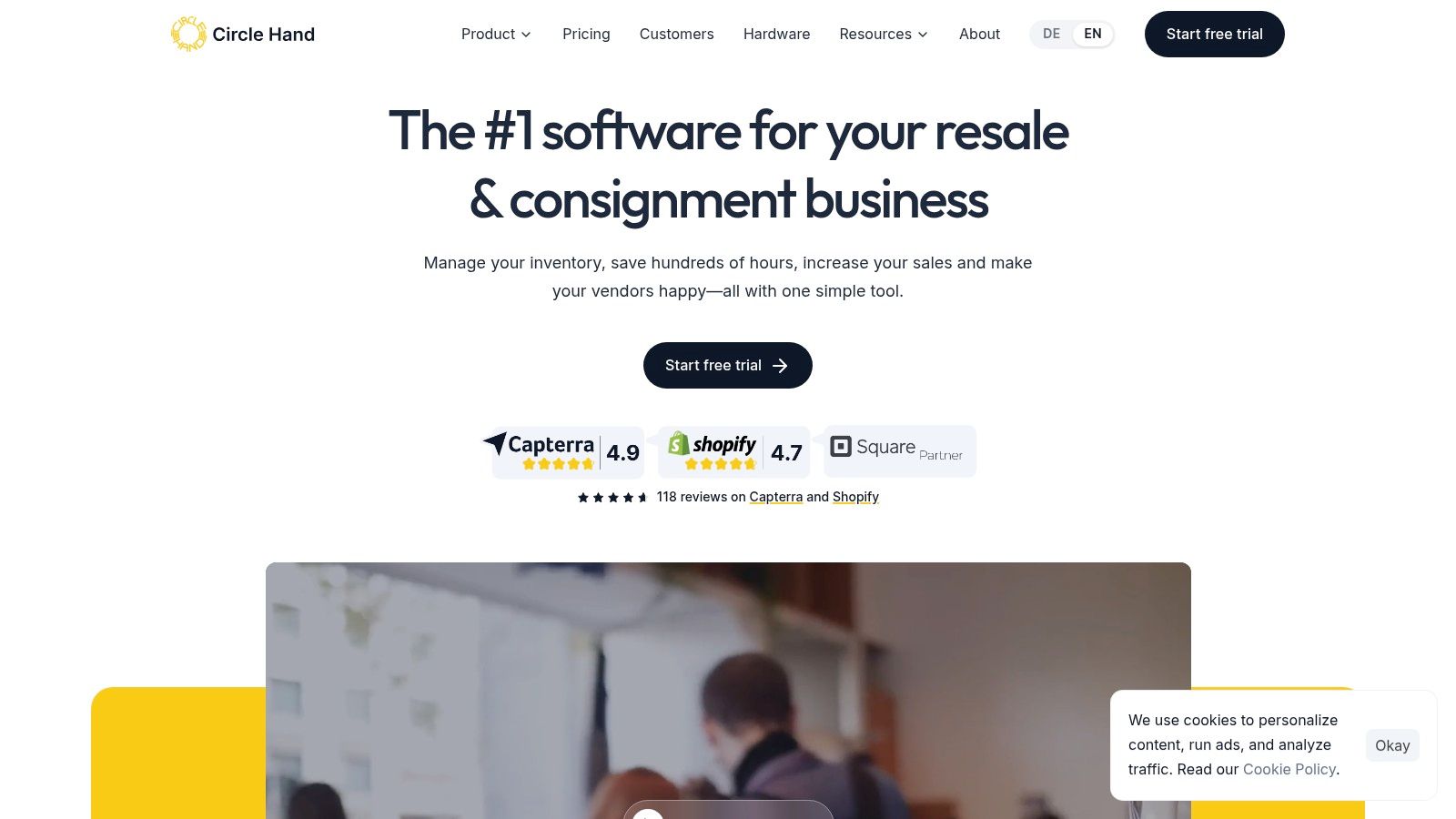
A store handling consigned, purchased and donated goods needs to distinguish ownership before calculating payouts. Circle-Hand supports those inventory models and connects with Shopify, Square and PayPal POS, also known as Zettle.
Current plan prices and their check date are unconfirmed. Its public plan structure includes higher tiers and custom arrangements, so the effective cost depends on locations, integrations and workflow requirements.
The mixed-inventory support is the important distinction. A donated item shouldn't generate a consignor liability. A purchased item shouldn't inherit a consignment split merely because staff entered it through a familiar intake screen.
Test the ownership distinction
- Consigned goods: Preserve the owner, agreement and applicable split.
- Purchased goods: Record store ownership and acquisition cost separately.
- Donations: Keep the item out of consignor payout calculations.
- Connected checkout: Confirm that the inventory type survives synchronization.
Circle-Hand also offers a client portal, email automation and AI assistance for item entry and pricing. Those tools should be evaluated against correction work, not the speed of a polished demonstration.
For example, staff should inspect whether suggested descriptions preserve condition details and whether pricing assistance can be overridden without losing the audit trail. The relevant labor measure includes review and correction.
Circle-Hand is a plausible fit for a shop whose inventory comes from several acquisition models. Its potential disadvantage is configuration complexity. A straightforward consignment-only store may not need the same breadth, particularly if location growth requires a more expensive tier.
5. ConsignR
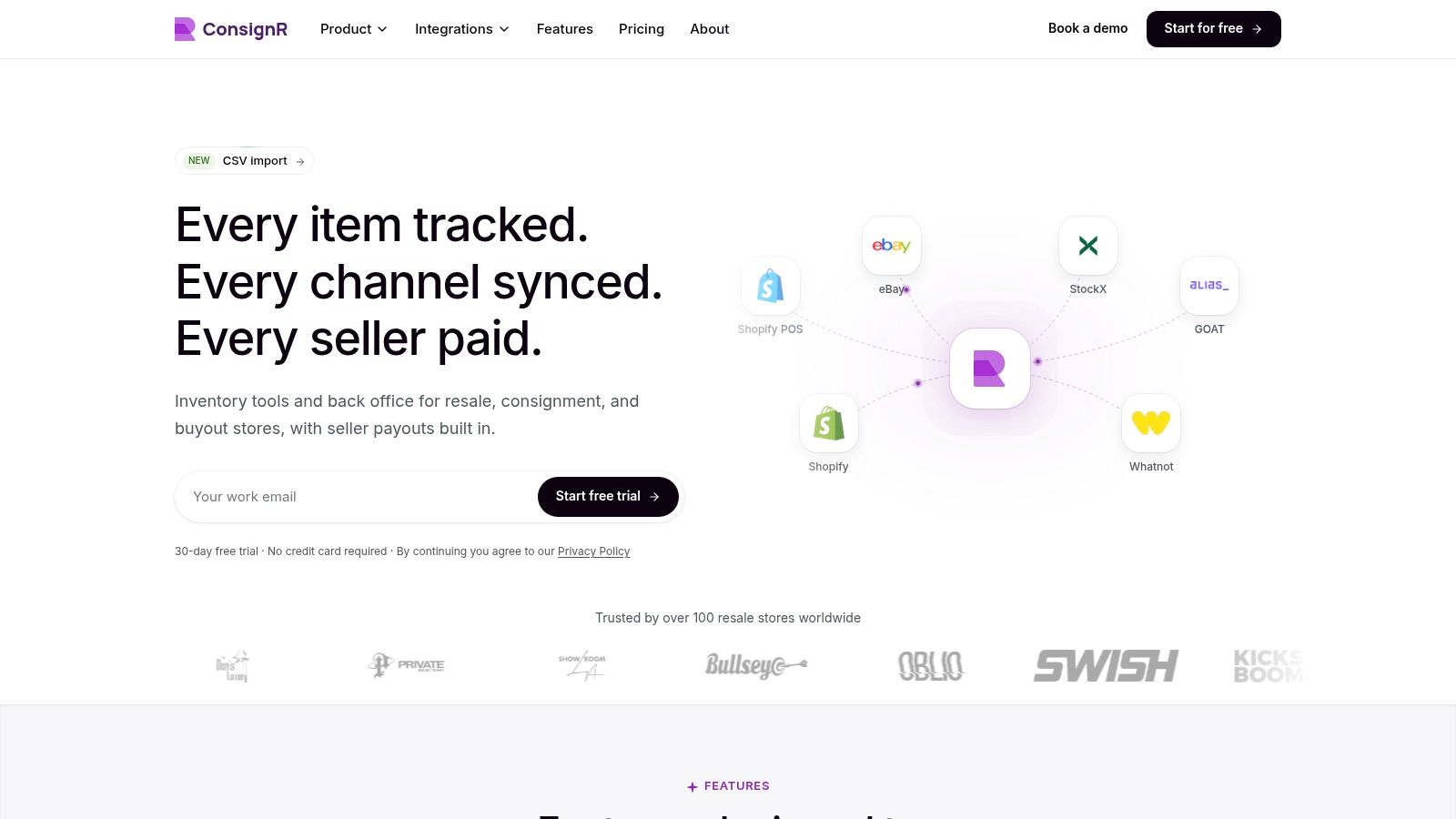
ConsignR's integration structure matters as much as its subscription tier. ConsignR lists Shopify synchronization as a free add-on, while its platform centers on inventory management, consignor self-service and ACH payouts.
Current subscription prices and the price-check date are unconfirmed. The free synchronization add-on shouldn't be interpreted as free Shopify service, free payment processing or free consignor transfers.
Lite includes unlimited inventory and users. Pro adds analytics, audits, UPC scanning, kiosk functionality and additional sales-channel tools. Enterprise is the relevant tier for multi-location support and data migration.
Separate integration access from operating cost
A shop retaining Shopify should identify which system owns each record. Product descriptions, markdowns, refunds and consignor balances need a clear update path.
- Shopify connection: Establish what synchronizes and how exceptions appear.
- ACH payouts: Determine applicable charges, failed-payment handling and reconciliation.
- Enterprise requirements: Include migration and location needs before comparing entry plans.
ConsignR's attraction is the ability to add inventory and self-service functions without treating Shopify synchronization as a separately priced software add-on. Its limitation is that operational requirements can move the purchase beyond Lite.
The payout demonstration should include an adjusted sale and a returned item. A portal displaying a balance isn't enough if staff can't explain how that balance changed.
For an established shop, migration eligibility may be more decisive than advanced scanning. Re-entering opening balances manually can erase the apparent saving from a lower subscription, particularly when staff must verify each consignor's position before the next payout run.
6. Rose by Consignor Connect
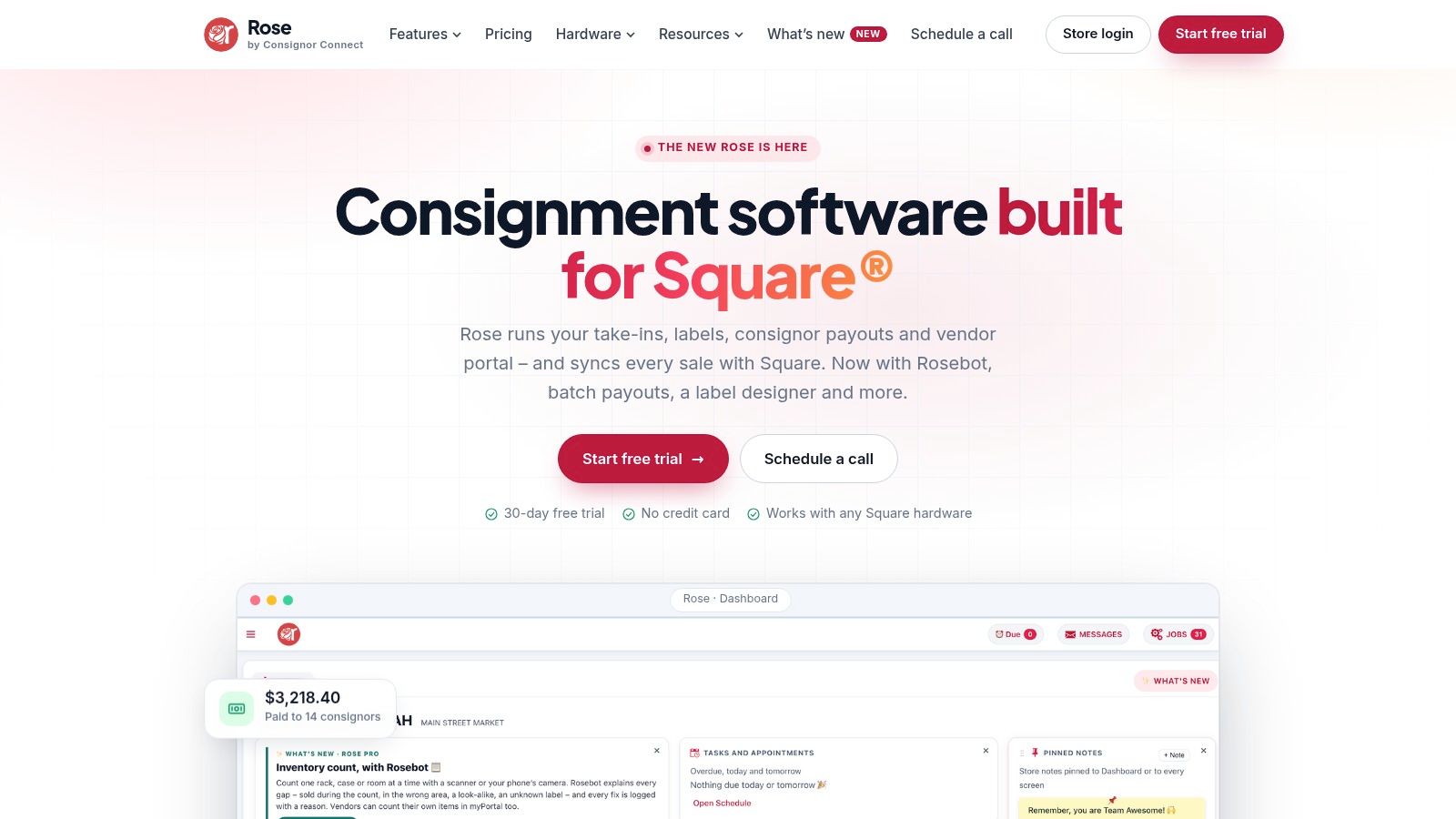
Rose's advertised entry price is not the workable starting point for a consignment shop. Rose by Consignor Connect works with Square, which supplies the checkout layer. Rose adds intake, labels, inventory, sales splits and consignor workflows on top.
The vendor lists a starting price of $30 per month per location. The boundary that matters is functional. Rose Lite doesn't include payout tracking or consignment management, so the cheapest plan fails the core test. A shop paying consignors should budget for an eligible higher tier, then add Square processing and any paid Square features on top.
Keeping a familiar checkout can spare an existing Square operator a full register replacement. It does not merge the two bills.
A familiar checkout reduces disruption. The Rose subscription and the Square bill still have to be added together.
Retail and Pro need different budgets
The tier split matters mainly for intake volume. Bulk label printing sits in a higher tier, so a shop processing frequent deliveries should confirm which plan includes it on the vendor's plan page before pricing the subscription. A smaller operation may not need the upgrade for labels alone.
The practical test follows a Square sale into Rose, then reverses it through a refund. Staff should see when inventory changes, when the consignor balance updates and how mismatched records are flagged.
Rose earns its place when retaining Square is an explicit requirement. The monthly figure combines the Rose plan, per-location billing, Square services and any tier upgrade the workflow needs. The $30 entry figure alone doesn't describe a workable consignment budget.
7. Aravenda
Aravenda is an ecommerce-led candidate, not just a replacement register. Aravenda combines consignor, inventory and payout workflows with Shopify POS integration, online inventory synchronization and remote item entry.
Current subscription prices and their check date are unconfirmed. Its plan structure includes higher-tier consignor entry and AI-assisted intake, while annual billing savings and included onboarding require attention to the applicable terms.
For a shop selling through connected channels, the central test is whether staff can maintain a reliable record of each unique item. Publishing listings is only part of that job. Returns, markdowns and sold-item availability also need consistent handling.
Evaluate the channel workflow
- Store sale: Confirm that online availability changes correctly.
- Online return: Establish when the item becomes sellable again.
- Remote intake: Check approval permissions before merchandise is published.
- Consignor entry: Verify that submitted items can't bypass required review.
The vendor describes onboarding and annual data conversion as included. The useful purchasing question is scope: which records are converted, which require cleanup and which historical details remain accessible?
Aravenda's broader channel focus may justify its place on an ecommerce-oriented shortlist. A local shop with limited online activity may not use enough of that functionality to justify the required package.
AI-assisted entry should also earn its place through reduced net labor. Staff should count review, corrections and missing condition details, rather than recording only the time needed to generate a draft. Consignor ownership and commission rules still require dependable structured records, regardless of how the description was created.
8. ConsignmentTill
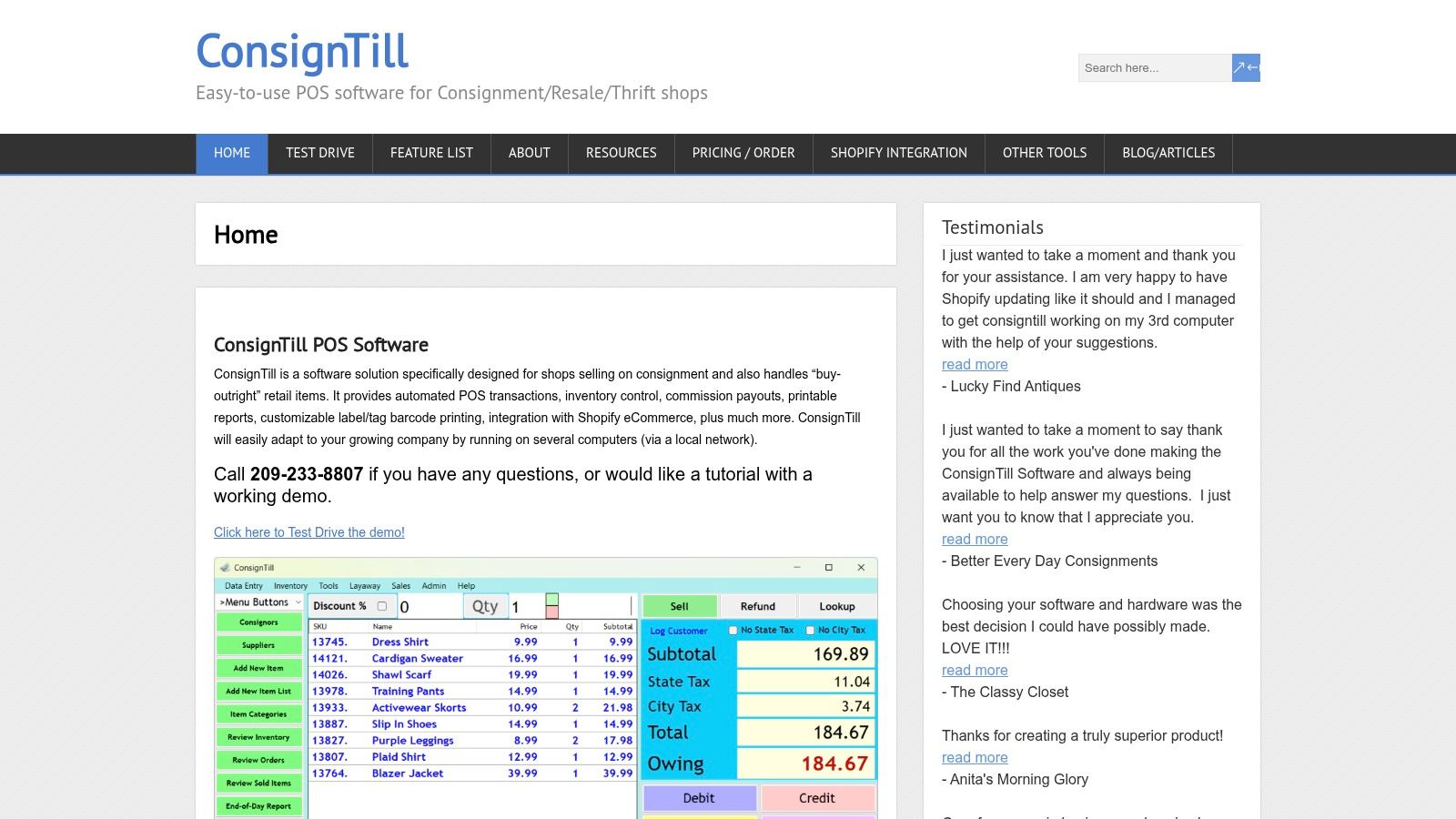
A local installation changes the cost model, not just the subscription. ConsignmentTill is a Windows-based consignment POS and inventory system that also supports buy-outright retail. Its functions include barcode scanning, customizable labels, commission tracking, payout handling, reports and Shopify integration.
Current vendor pricing and license terms are unconfirmed. Directory references to subscription and one-time licensing aren't a substitute for a current vendor quote, so no starting price is treated as verified here.
Local Windows software can suit a store that wants its working environment on shop computers. The trade-off is responsibility for the machines, networking and recovery arrangements.
Compare ownership costs with hosted access
- Hardware: Include compatible computers, scanners and label printers.
- Networking: Establish how connected workstations access the records.
- Recovery: Assign responsibility for backups and test restoration.
- Software terms: Separate the license from updates, support and integrations.
A one-time license shouldn't automatically be described as the cheaper option. The shop still needs an operating plan for equipment failure and software maintenance.
The demonstration should include the actual label printer and intended workstation arrangement. Successful intake on a demonstration computer doesn't establish that the store's hardware can print readable tags or that connected registers behave correctly.
ConsignmentTill belongs on the shortlist when local Windows operation is a deliberate preference. Teams needing browser-based access from varied devices should weigh that requirement before comparing license formats. Payout records must also remain recoverable if the main store computer becomes unavailable.
9. Liberty Cloud
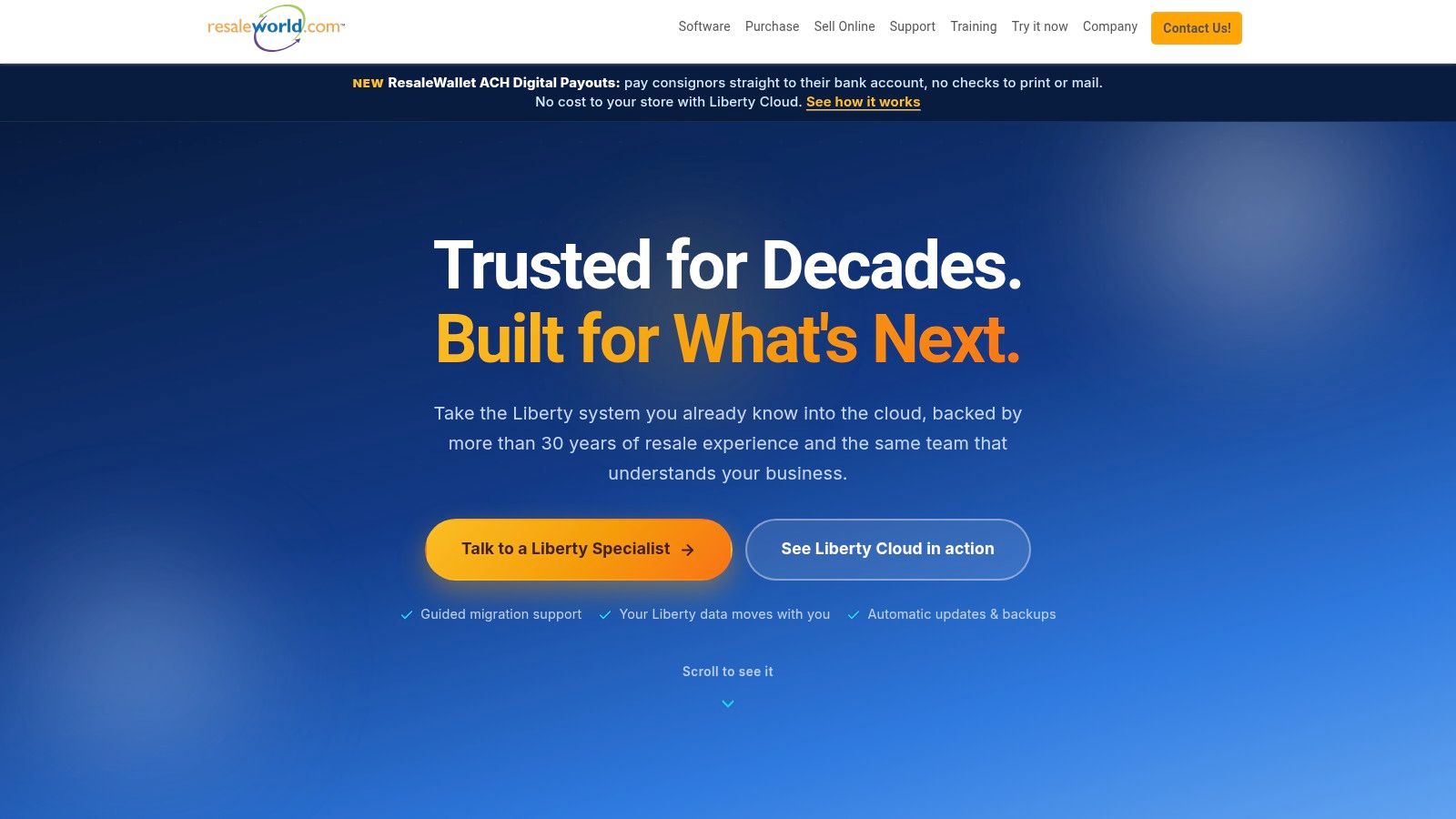
Liberty Cloud from Resaleworld is the hosted version of its Liberty software family for consignment, resale and antique stores. It covers POS, inventory, client accounts, payouts and reporting, with cloud access, updates and backups.
Current starting pricing and the price-check date are unconfirmed. Older published figures shouldn't be treated as a current offer, particularly when hardware, migration and the selected configuration remain unresolved.
The hosted arrangement is the central distinction from maintaining a store server. Resaleworld lists access from PCs, Macs, laptops and tablets, alongside automatic updates and off-site backups.
Hosting doesn't remove migration work
Guided migration and technical support can reduce the shop's implementation burden. They don't eliminate the need to reconcile the transferred records.
- Opening liabilities: Match unpaid consignor balances to the previous system.
- Inventory status: Separate available, sold, returned and expired items.
- Historical access: Establish how staff retrieve older sales and payout details.
Migration safeguard: Staff should approve ownership and unpaid balances before accepting the new system as the operational record.
Liberty Cloud is relevant to a store seeking hosted access to a consignment-focused software family. Its possible disadvantage is paying for a broader environment than a lightweight operation needs.
The purchasing comparison should distinguish hosting, support, migration and equipment. A package can reduce server maintenance while still requiring compatible checkout hardware. The strongest demonstration will trace a sale through tax reporting, payment summaries and the resulting consignor liability, rather than showing each report separately without proving that the totals agree.
10. Consignloop
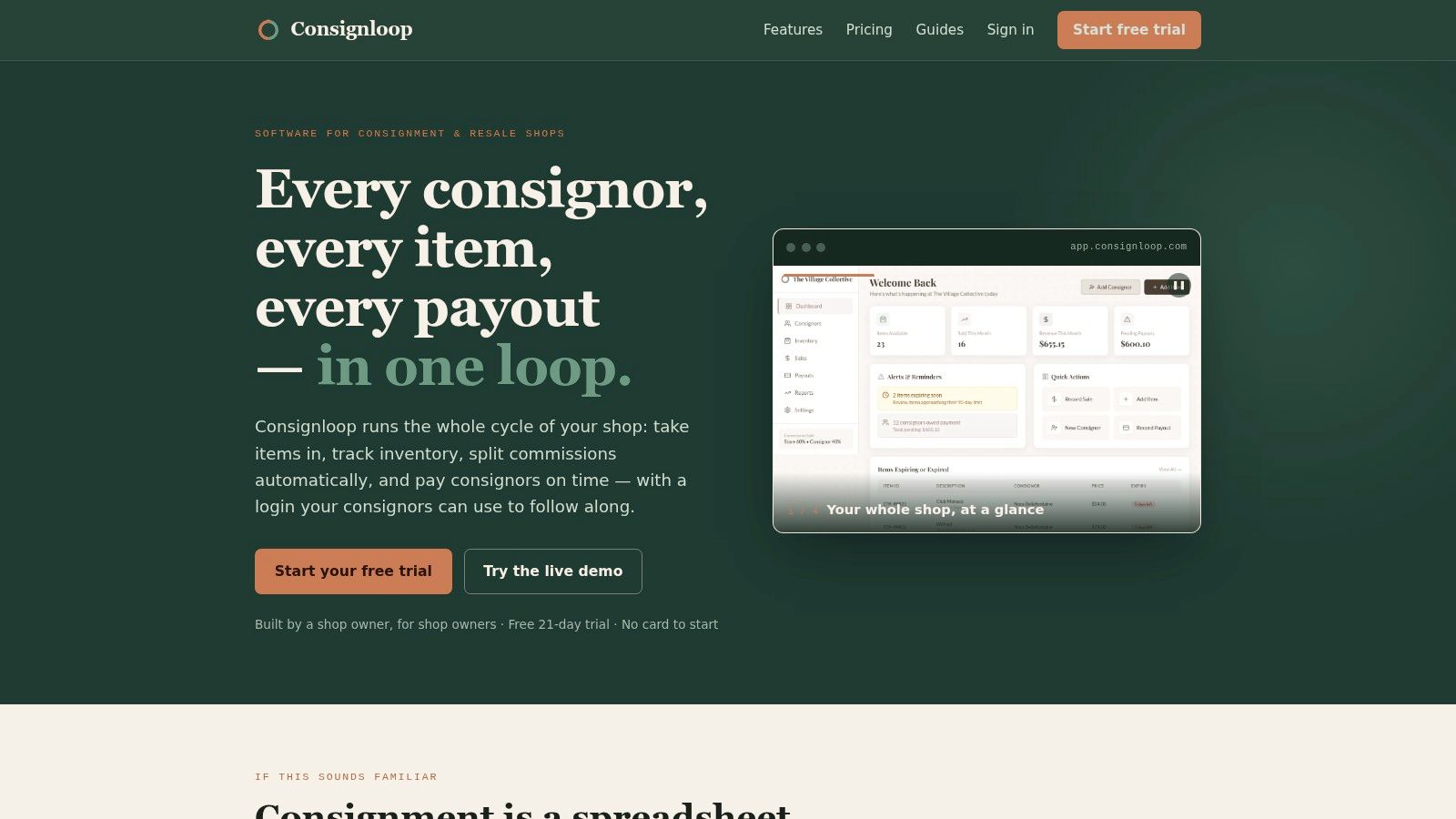
Consignloop is the low-entry-cost candidate in this shortlist, but the required integration tier needs verification. Its core workflows cover consignor accounts, inventory, price tags, expiry tracking, sale splits, payout balances and reporting.
The published plan descriptions identify Growth with consignor logins and self-service intake. Pro adds Square POS integration and photo-assisted item entry. However, the vendor's broader feature wording also describes Square synchronization across plans, creating a boundary that should be resolved before purchase.
The right comparison therefore isn't the entry subscription against a competing full-featured plan. It is the lowest Consignloop tier that supports the shop's checkout and consignor workflow.
Use the trial for settlement work
- Intake: Preserve item ownership, expiry terms and the applicable commission.
- Checkout: Confirm that a sale creates the expected consignor balance.
- Returns: Reverse the correct liability without losing the original record.
- Payouts: Match statements and balances to the amounts paid.
Consignloop can be a sensible starting candidate for a smaller shop that doesn't need every advanced workflow immediately. Its limitations should be evaluated through documented plan entitlements and practical transaction checks, rather than assumptions based on the starting price.
Online selling also needs a separate budget if the selected arrangement requires another platform. Rankozo's ecommerce platforms comparison helps identify that additional service category.
The purchase should proceed only when the selected plan's Square access, payout functions and data export capabilities are clear. A low subscription is useful when it covers the required work without forcing staff back into reconciliation spreadsheets.
Vendor-listed starting prices, consignor portals and trials across 10 consignment systems
The workable starting plan is the cheapest tier that still pays consignors. Payout fees, a portal locked to a higher tier, per-location billing, and a POS or license add-on are what move the monthly bill.
| System | Consignor payouts or portal | Free trial or free import | What pushes the bill up |
|---|---|---|---|
| SimpleConsign | Automated consignor payouts and accounts | Free data migration advertised | Payout automation has to be on the plan you actually buy |
| ConsignCloud | Pro includes a consignor portal; ACH payouts available for a fee | Free data import on Basic | Portal sits on Pro, and ACH is an extra fee |
| Ricochet POS | Consignor app or portal and payout reporting | Not stated | Portal plus payout reporting, with no stated trial to test settlement |
| Circle-Hand | Consignor or client portal | Free data import advertised | Client portal access, separate from the import offer |
| ConsignR | Self-service portal and ACH payouts | Not stated | ACH payouts on top of the portal |
| Rose by Consignor Connect | Portal and payout tracking on eligible plans | Not stated | Billed per location, and portal tracking only on eligible plans |
| Aravenda | Consignor portal and payout workflows | Annual data conversion included | Portal and payout workflows, with conversion tied to an annual term |
| ConsignmentTill | Payout handling | Not stated | Subscription or a one-time license, two different cash timings |
| Liberty Cloud | Client accounts and payout management | Guided migration listed; free import not specified | Accounts and payout management, with migration guided rather than a free import |
| Consignloop | Payout balances; self-service intake on Growth | 21-day free trial | Growth if consignors enter items themselves |
ConsignCloud is the clearest split between a teaser and the operating cost. Basic includes a free data import. The consignor portal is on Pro, and ACH payouts cost a fee. A shop that imports on Basic and then needs the portal is already on a higher tier before the first settlement run.
Consignloop is the only system here with a stated trial, 21 days. Payout balances are the test. Self-service intake is on Growth, so a shop that wants consignors to enter their own items should price that tier, not the entry plan.
Rose bills per location, and portal plus payout tracking apply only on eligible plans. One extra location, or a step up for tracking, changes the invoice even if the first site looked cheap. ConsignmentTill offers a subscription or a one-time license. Those are different bills, not two labels for the same product.
Import offers are not trials. SimpleConsign and Circle-Hand advertise free data import or migration. Aravenda includes data conversion on an annual term. Liberty Cloud lists guided migration and does not specify a free import. Ricochet POS, ConsignR, and ConsignmentTill do not state a trial, so payout reporting, ACH, or payout handling has to be checked in a paid demo rather than a free window.
Choosing the Cheapest System That Still Pays Consignors Right
Start with the lowest plan that covers consignor payouts, then calculate the complete operating bill. Include per-location charges, payout fees, payment processing, POS integrations, ecommerce services and required upgrades. Where several billing options appear, identify whether the quote assumes monthly payment, an annual commitment or an introductory period.
Payout handling deserves its own acceptance test. A system can calculate a balance correctly and still leave staff unable to reconcile adjustments. That system is not finished from an operational perspective.
The Future Market Insights consignment-software report identifies inventory tracking, payout management, POS and reporting as core modules. A purchasing demonstration should connect those functions through intake, markdown, sale, return and settlement, with an audit trail showing who changed the record.
Preserve the agreement attached to the item
Commission changes are a particularly useful test. A new agreement shouldn't rewrite the terms attached to merchandise already accepted.
Secnd's consignment-store documentation, published in 2026, describes stamping the applicable split onto an item at intake, with overrides by consignor or item. That illustrates the control buyers should evaluate across candidates: the payout must reflect the correct agreement, not merely the consignor's latest default setting.
- Before migration: Export active inventory, ownership records and unpaid balances.
- Before launch: Reconcile imported totals and investigate exceptions.
- Before settlement: Verify returns, adjustments and failed payments.
- Before renewal: Recheck the applicable plan, location charges and connected services.
Automation should face the same scrutiny. A photo-generated description that needs extensive correction may not reduce intake labor. A synchronized listing that remains available after sale can create a refund and a consignor dispute.
The cheapest suitable consignment store software is therefore the system with the lowest supported operating cost, not necessarily the smallest subscription. Consignloop deserves consideration for a low-cost start. ConsignCloud makes processing and payout charges particularly visible. Rose warrants attention for Square-based shops, while the other candidates address different combinations of hosted access, local installation, mixed inventory and ecommerce.
Unconfirmed prices stay out of the comparison. Where a vendor publishes no starting figure, the package has to come from a sales conversation, and the quote should be written down with its billing conditions. A purchasing decision needs a current package with explicit entitlements, not an older figure detached from its terms.
Before signing, the shop's owner or procurement lead should build a written cost sheet for the preferred candidates and run a sale, return and payout through each proposed configuration. Rankozo's inventory, POS and ecommerce comparisons can help identify adjacent subscriptions that belong in that budget. The final choice should be the lowest-cost package whose inventory records, consignor statements and actual payments reconcile.
Questions or corrections: editorial@rankozo.com